Showing posts with label War. Show all posts

Wednesday, August 4, 2010

Veteran Intelligence Professionals for Sanity: Israel May Bomb Iran This Month

Are you standing on the Rock of Salvation?

Source: http://theintelhub.com

MEMORANDUM FOR: The President

FROM: Veteran Intelligence Professionals for Sanity (VIPS)

We write to alert you to the likelihood that Israel will attack Iran as early as this month. This would likely lead to a wider war.

Israel’s leaders would calculate that once the battle is joined, it will be politically untenable for you to give anything less than unstinting support to Israel, no matter how the war started, and that U.S. troops and weaponry would flow freely. Wider war could eventually result in destruction of the state of Israel.


This can be stopped, but only if you move quickly to pre-empt an Israeli attack by publicly condemning such a move before it happens.

We believe that comments by senior American officials, you included, reflect misplaced trust in Israeli Prime Minister [Benjamin] Netanyahu.

Actually, the phrasing itself can be revealing, as when CIA Director Panetta implied cavalierly that Washington leaves it up to the Israelis to decide whether and when to attack Iran, and how much “room” to give to the diplomatic effort.

On June 27, Panetta casually told ABC’s Jake Tapper, “I think they are willing to give us the room to be able to try to change Iran diplomatically … as opposed to changing them militarily.”


Similarly, the tone you struck referring to Netanyahu and yourself in your July 7 interview with Israeli TV was distinctly out of tune with decades of unfortunate history with Israeli leaders.

“Neither of us try to surprise each other,” you said, “and that approach is one that I think Prime Minister Netanyahu is committed to.” You may wish to ask Vice President Biden to remind you of the kind of surprises he has encountered in Israel.

Blindsiding has long been an arrow in Israel’s quiver. During the emerging Middle East crisis in the spring of 1967, some of us witnessed closely a flood of Israeli surprises and deception, as Netanyahu’s predecessors feigned fear of an imminent Arab attack as justification for starting a war to seize and occupy Arab territories.

We had long since concluded that Israel had been exaggerating the Arab “threat” — well before 1982 when former Israeli Prime Minister Menachem Begin publicly confessed:

“In June 1967, we had a choice. The Egyptian army concentrations in the Sinai approaches do not prove that [Egyptian President] Nasser was really about to attack us. We must be honest with ourselves. We decided to attack him.”

Israel had, in fact, prepared well militarily and also mounted provocations against its neighbors, in order to provoke a response that could be used to justify expansion of its borders.

Given this record, one would be well advised to greet with appropriate skepticism any private assurances Netanyahu may have given you that Israel would not surprise you with an attack on Iran.

Netanyahu’s Calculations

Netanyahu believes he holds the high cards, largely because of the strong support he enjoys in our Congress and our strongly pro-Israel media. He reads your reluctance even to mention in controversial bilateral issues publicly during his recent visit as affirmation that he is in the catbird seat in the relationship.

During election years in the U.S. (including mid-terms), Israeli leaders are particularly confident of the power they and the Likud Lobby enjoy on the American political scene.

This prime minister learned well from Menachem Begin and Ariel Sharon.

Netanyahu’s attitude comes through in a video taped nine years ago and shown on Israeli TV, in which he bragged about how he deceived President Clinton into believing he (Netanyahu) was helping implement the Oslo accords when he was actually destroying them.

The tape displays a contemptuous attitude toward — and wonderment at — an America so easily influenced by Israel. Netanyahu says:

“America is something that can be easily moved. Moved in the right direction. … They won’t get in our way … Eighty percent of the Americans support us. It’s absurd.”

Israeli columnist Gideon Levy wrote that the video shows Netanyahu to be “a con artist … who thinks that Washington is in his pocket and that he can pull the wool over its eyes,” adding that such behavior “does not change over the years.”

As mentioned above, Netanyahu has had instructive role models.

None other than Gen. Brent Scowcroft told the Financial Times that former Israeli Prime Minister Ariel Sharon had George W. Bush “mesmerized;” that “Sharon just has him “wrapped around his little finger.”

(Scowcroft was promptly relieved of his duties as chair of the prestigious President’s Foreign Intelligence Advisory Board and told never again to darken the White House doorstep.)

If further proof of American political support for Netanyahu were needed, it was manifest when Senators McCain, Lieberman, and Graham visited Israel during the second week of July.

Lieberman asserted that there is wide support in Congress for using all means to keep Iran from becoming a nuclear power, including “through military actions if we must.” Graham was equally explicit: “The Congress has Israel’s back,” he said.

More recently, 47 House Republicans have signed onto H.R. 1553 declaring “support for Israel’s right to use all means necessary to confront and eliminate nuclear threats posed by Iran … including the use of military force.”

The power of the Likud Lobby, especially in an election year, facilitates Netanyahu’s attempts to convince those few of his colleagues who need convincing that there may never be a more auspicious time to bring about “regime change” in Tehran.

And, as we hope your advisers have told you, regime change, not Iranian nuclear weapons, is Israel’s primary concern.

If Israel’s professed fear that one or two nuclear weapons in Iran’s arsenal would be a game changer, one would have expected Israeli leaders to jump up and down with glee at the possibility of seeing half of Iran’s low enriched uranium shipped abroad.

Instead, they dismissed as a “trick” the tripartite deal, brokered by Turkey and Brazil with your personal encouragement, that would ship half of Iran’s low enriched uranium outside Tehran’s control.

The National Intelligence Estimate

The Israelis have been looking on intently as the U.S. intelligence community attempts to update, in a “Memorandum to Holders,” the NIE of November 2007 on Iran’s nuclear program. It is worth recalling a couple of that Estimate’s key judgments:

“We judge with high confidence that in fall of 2003 Tehran halted its nuclear weapons program. … We assess with moderate confidence Tehran has not restarted its nuclear program as of mid-2007, but we do not know whether it currently intends to develop nuclear weapons …”

Earlier this year, public congressional testimony by former Director of National Intelligence Dennis Blair (February 1 & 2) and Defense Intelligence Agency Director Gen. Ronald Burgess with Vice Chairman of the Joint Chiefs Gen. James Cartwright (April 14) did not alter those key judgments.

Blair and others continued to underscore the intelligence community’s agnosticism on one key point: as Blair put it earlier this year, “We do not know if Iran will eventually decide to build a nuclear weapon.”

The media have reported off-the-cuff comments by Panetta and by you, with a darker appraisal — with you telling Israeli TV “… all indicators are that they [the Iranians] are in fact pursuing a nuclear weapon;” and Panetta telling ABC, “I think they continue to work on designs in that area [of weaponization].”

Panetta hastened to add, though, that in Tehran, “There is a continuing debate right now as to whether or not they ought to proceed with the bomb.”

Israel probably believes it must give more weight to the official testimony of Blair, Burgess, and Cartwright, which dovetail with the earlier NIE, and the Israelis are afraid that the long-delayed Memorandum to Holders of the 2007 NIE will essentially affirm that Estimate’s key judgments.

Our sources tell us that an honest Memorandum to Holders is likely to do precisely that, and that they suspect that the several-months-long delay means intelligence judgments are being “fixed” around the policy — as was the case before the attack on Iraq.

One War Prevented

The key judgments of the November 2007 NIE shoved an iron rod into the wheel spokes of the Dick Cheney-led juggernaut rolling toward war on Iran. The NIE infuriated Israel leaders eager to attack before President Bush and Vice President Cheney left office. This time, Netanyahu fears that issuance of an honest Memorandum might have similar effect.

Bottom line: more incentive for Israel to pre-empt such an Estimate by striking Iran sooner rather than later.

Last week’s announcement that U.S. officials will meet next month with Iranian counterparts to resume talks on ways to arrange higher enrichment of Iranian low enriched uranium for Tehran’s medical research reactor was welcome news to all but the Israeli leaders.

In addition, Iran reportedly has said it would be prepared to halt enrichment to 20 percent (the level needed for the medical research reactor), and has made it clear that it looks forward to the resumption of talks.

Again, an agreement that would send a large portion of Iran’s LEU abroad would, at a minimum, hinder progress toward nuclear weapons, should Iran decide to develop them. But it would also greatly weaken Israel’s scariest rationale for an attack on Iran.

Bottom line: with the talks on what Israel’s leaders earlier labeled a “trick” now scheduled to resume in September, incentive builds in Tel Aviv for the Israelis to attack before any such agreement can be reached.

We’ll say it again: the objective is regime change. Creating synthetic fear of Iranian nuclear weapons is simply the best way to “justify” bringing about regime change. Worked well for Iraq, no?

Another War in Need of Prevention

A strong public statement by you, personally warning Israel not to attack Iran would most probably head off such an Israeli move. Follow-up might include dispatching Adm. Mullen to Tel Aviv with military-to-military instructions to Israel: Don’t Even Think of It.

In the wake of the 2007 NIE, President Bush overruled Vice President Cheney and sent Adm. Mullen to Israel to impart that hard message. A much-relieved Mullen arrived home that spring sure of step and grateful that he had dodged the likelihood of being on the end of a Cheney-inspired order for him to send U.S. forces into war with Iran.

This time around, Mullen returned with sweaty palms from a visit to Israel in February 2010. Ever since, he has been worrying aloud that Israel might mousetrap the U.S. into war with Iran, while adding the obligatory assurance that the Pentagon does have an attack plan for Iran, if needed.

In contrast to his experience in 2008, though, Mullen seemed troubled that Israel’s leaders did not take his warnings seriously.

While in Israel, Mullen insisted publicly that an attack on Iran would be “a big, big, big problem for all of us, and I worry a great deal about the unintended consequences.”

After his return, at a Pentagon press conference on Feb. 22 Mullen drove home the same point. After reciting the usual boilerplate about Iran being “on the path to achieve nuclear weaponization” and its “desire to dominate its neighbors,” he included the following in his prepared remarks:

“For now, the diplomatic and the economic levers of international power are and ought to be the levers first pulled. Indeed, I would hope they are always and consistently pulled. No strike, however effective, will be, in and of itself, decisive.”

Unlike younger generals — David Petraeus, for example — Adm. Mullen served in the Vietnam War. That experience is probably what prompts asides like this: “I would remind everyone of an essential truth: War is bloody and uneven. It’s messy and ugly and incredibly wasteful …”

Although the immediate context for that remark was Afghanistan, Mullen has underscored time and again that war with Iran would be a far larger disaster. Those with a modicum of familiarity with the military, strategic and economic equities at stake know he is right.

Other Steps

In 2008, after Mullen read the Israelis the riot act, they put their pre-emptive plans for Iran aside. With that mission accomplished, Mullen gave serious thought to ways to prevent any unintended (or, for that matter, deliberately provoked) incidents in the crowded Persian Gulf that could lead to wider hostilities.

Mullen sent up an interesting trial balloon at a July 2, 2008, press conference, when he indicated that military-to-military dialogue could “add to a better understanding” between the U.S. and Iran. But nothing more was heard of this overture, probably because Cheney ordered him to drop it.

It was a good idea — still is. The danger of a U.S.-Iranian confrontation in the crowded Persian Gulf has not been addressed, and should be. Establishment of a direct communications link between top military officials in Washington and Tehran would reduce the danger of an accident, miscalculation, or covert, false-flag attack.

In our view, that should be done immediately — particularly since recently introduced sanctions assert a right to inspect Iranian ships. The naval commander of the Iranian Revolutionary Guards reportedly has threatened “a response in the Persian Gulf and the Strait of Hormuz,” if anyone tries to inspect Iranian ships in international waters.

Another safety valve would result from successful negotiation of the kind of bilateral “incidents-at-sea” protocol that was concluded with the Russians in 1972 during a period of relatively high tension.

With only interim nobodies at the helm of the intelligence community, you may wish to consider knocking some heads together yourself and insisting that it finish an honest Memorandum to Holders of the 2007 NIE by mid-August — recording any dissents, as necessary.

Sadly, our former colleagues tell us that politicization of intelligence analysis did not end with the departure of Bush and Cheney…and that the problem is acute even at the State Department’s Bureau of Intelligence and Research, which in the past has done some of the best professional, objective, tell-it-like-it-is analysis.

Pundits, Think Tanks: Missing the Point

As you may have noticed, most of page one of Sunday’s Washington Post Outlook section was given to an article titled, “A Nuclear Iran: Would America Strike to Prevent It? — Imagining Obama’s Response to an Iranian Missile Crisis.”

Page five was dominated by the rest of the article, under the title “Who will blink first when Iran is on the brink?”

A page-wide photo of a missile rolling past Iranian dignitaries on a reviewing stand (reminiscent of the familiar parades on Red Square) is aimed at the centerfold of the Outlook section, as if poised to blow it to smithereens.

Typically, the authors address the Iranian “threat” as though it endangers the U.S., even though Secretary Clinton has stated publicly that this is not the case. They write that one option for the U.S. is “the lonely, unpopular path of taking military action lacking allied consensus.” O Tempora, O Mores!

In less than a decade, wars of aggression have become nothing more than lonely, unpopular paths.

What is perhaps most remarkable, though, is that the word Israel is nowhere to be found in this very long article. Similar think pieces, including some from relatively progressive think tanks, also address these issues as though they were simply bilateral U.S.-Iranian problems, with little or no attention to Israel.

Guns of August?

The stakes could hardly be higher. Letting slip the dogs of war would have immense repercussions. Again, we hope that Adm. Mullen and others have given you comprehensive briefings on them.

Netanyahu would be taking a fateful gamble by attacking Iran, with high risk to everyone involved. The worst, but conceivable case, has Netanyahu playing — unintentionally — Dr. Kevorkian to the state of Israel.

Even if the U.S. were to be sucked into a war provoked by Israel, there is absolutely no guarantee that the war would come out well.

Were the U.S. to suffer significant casualties, and were Americans to become aware that such losses came about because of exaggerated Israeli claims of a nuclear threat from Iran, Israel could lose much of its high standing in the United States.

There could even be an upsurge in anti-Semitism, as Americans conclude that officials with dual loyalties in Congress and the executive branch threw our troops into a war provoked, on false pretenses, by Likudniks for their own narrow purposes.

We do not have a sense that major players in Tel Aviv or in Washington are sufficiently sensitive to these critical factors.

You are in position to prevent this unfortunate, but likely chain reaction. We allow for the possibility that Israeli military action might not lead to a major regional war, but we consider the chances of that much less than even.

Footnote: VIPS Experience

We VIPS have found ourselves in this position before. We prepared our first Memorandum for the President on the afternoon of February 5, 2003 after Colin Powell’s speech at the UN.

We had been watching how our profession was being corrupted into serving up faux intelligence that was later criticized (correctly) as “uncorroborated, contradicted, and nonexistent” — adjectives used by former Senate Intelligence Committee chair Jay Rockefeller after a five-year investigation by his committee.

As Powell spoke, we decided collectively that the responsible thing to do was to try to warn the President before he acted on misguided advice to attack Iraq. Unlike Powell, we did not claim that our analysis was “irrefutable and undeniable.” We did conclude with this warning:

“After watching Secretary Powell today, we are convinced that you would be well served if you widened the discussion … beyond the circle of those advisers clearly bent on a war for which we see no compelling reason and from which we believe the unintended consequences are likely to be catastrophic.”

http://www.afterdowningstreet.org/downloads/vipstwelve.pdf

We take no satisfaction at having gotten it right on Iraq. Others with claim to more immediate expertise on Iraq were issuing similar warnings. But we were kept well away from the wagons circled by Bush and Cheney.

Sadly, your own Vice President, who was then chair of the Senate Foreign Affairs Committee, was among the most assiduous in blocking opportunities for dissenting voices to be heard. This is part of what brought on the worst foreign policy disaster in our nation’s history.

We now believe that we may also be right on (and right on the cusp of) another impending catastrophe of even wider scope — Iran — on which another President, you, are not getting good advice from your closed circle of advisers.

They are probably telling you that, since you have privately counseled Prime Minister Netanyahu against attacking Iran, he will not do it. This could simply be the familiar syndrome of telling the President what they believe he wants to hear.

Quiz them; tell them others believe them to be dead wrong on Netanyahu. The only positive here is that you — only you — can prevent an Israeli attack on Iran.

Steering Group, Veteran Intelligence Professionals for Sanity (VIPS)

Ray Close, Directorate of Operations, Near East Division, CIA (26 years)

Phil Giraldi, Directorate of Operations, CIA (20 years)

Larry Johnson, Directorate of Intelligence, CIA; Department of State, Department of Defense consultant (24 years)

W. Patrick Lang, Col., USA, Special Forces (ret.); Senior Executive Service: Defense Intelligence Officer for Middle East/South Asia, Director of HUMINT Collection, Defense Intelligence Agency (30 years)

Ray McGovern, US Army Intelligence Officer, Directorate of Intelligence, CIA (30 years)

Coleen Rowley, Special Agent and Minneapolis Division Counsel, FBI (24 years)

Ann Wright, Col., US Army Reserve (ret.), (29 years); Foreign Service Officer, Department of State (16 years)


..........................................................................................................................

Isaiah 55:6Make search for the Lord while he is there, make prayer to him while he is near:Isaiah 55:7Let the sinner give up his way, and the evil-doer his purpose: and let him come back to the Lord, and he will have mercy on him, and to our God, for there is full forgiveness with him.
John 3:16
For God had such love for the world that he gave his only Son so that whoever has faith in him may not come to destruction but have eternal life

God bless you!

Sunday, July 25, 2010

Resolution Green-Lighting Israeli Strikes on Iran Introduced by House Republicans

Are you standing on the Rock of Salvation?

Source: http://www.informationclearinghouse.info

"Huffington Post" -- Republicans in the House of Representatives have introduced a measure that would green-light an Israeli bombing campaign against Iran. The resolution, H.Res. 1553 (in full below), provides explicit support for military strikes against Iran, stating that Congress supports Israel's use of "all means necessary" against Iran "including the use of military force". US military leaders have warned that strikes could be catastrophic to US national security interests and could engulf the Middle East in a "calamitous" regional war.

Nearly a third of House Republicans have signed onto the resolution, which has been publicly discussed and circulated by its lead sponsor, Rep. Louie Gohmert (R-TX), for months. The National Iranian American Council is leading calls to oppose the measure, urging those concerned to demand that House Republican Leader John Boehner denounce the resolution.

The introduction of the measure coincides with a pattern of renewed calls for military strikes that have escalated since President Obama signed "crippling" Congressional Iran sanctions into law. Neoconservatives who were instrumental in orchestrating the Iraq War, such as Bill Kristol, and Reuel Marc Gerecht, have led the stepped up calls for military action.

Hawkish former Bush Administration official John Bolton recently laid out the game plan to prod Israel into attacking Iran, arguing that outsiders can "create broad support" for a strike by framing it as an issue of Israel's right to self defense. Supporters for military strikes, Bolton says, should "defend the specific tactic of pre-emptive attacks" against Iran. He urges that Congress can "make it clear" that it supports such strikes and that "having visible congressional support in place at the outset will reassure the Israeli government, which is legitimately concerned about Mr. Obama's likely negative reaction to such an attack."

In spite of enthusiasm from the neocons, top US military leaders have warned of the many dangers of military strikes against Iran. Defense Secretary Robert Gates has argued, "Another war in the Middle East is the last thing we need. In fact, I believe it would be disastrous on a number of levels." Admiral Mike Mullen, Chairman of the Joint Chiefs has expressed his own serious reservations about an attack, stating, "Iran getting a nuclear weapon would be incredibly destabilizing. Attacking them would also create the same kind of outcome. In an area that's so unstable right now, we just don't need more of that." General David Petraeus has warned that a strike on Iran would be utilized by the Iranian government to unite it's otherwise divided populace.

Simulations have been conducted over the past year to assess the outcome of a preemptive military strike against Iran. One such simulation, by the Brookings Institution's Saban Center, found that strikes would draw the US into the conflict that would engulf the region into war, and would enable Iran to use the attacks as an opportunity to unite the Iranian people and dismantle its opposition. The simulation also found that the strikes could not destroy Iran's nuclear program but merely set it back a few years.

An Oxford Research Group report released recently reinforced those findings and also warned that an Israeli attack would be disastrous and would be unlikely to stop Iran's nuclear program. Instead, the report concluded attacks could convince Iran to withdraw from the international Nuclear Non-proliferation Treaty and to aggressively seek to develop nuclear weapons.

Iranian activists have urged that even raising the specter of war undercuts the opposition in Iran. "The mere fact that Obama didn't make military threats made the Green Movement possible," noted Akbar Ganji. "A military attack would destroy all of that."


Iran Resolution -

....................................................................................................................................
Isaiah 55:6
Make search for the Lord while he is there, make prayer to him while he is near:Isaiah 55:7Let the sinner give up his way, and the evil-doer his purpose: and let him come back to the Lord, and he will have mercy on him, and to our God, for there is full forgiveness with him.
John 3:16
For God had such love for the world that he gave his only Son so that whoever has faith in him may not come to destruction but have eternal life

God bless you!

Saturday, July 24, 2010

War on Terror or War of Terror?

Are you standing on the Rock of Salvation?

Source: http://www.counterpunch.org

Critical evidence from the British government and other sources suggest that the “War on Terror” has actually destabilized the Middle East and increased the terror threat throughout the globe. The former head of Britain’s MI5 – Baroness Manningham-Buller – finds that the Iraq war has dramatically contributed to the growing terror danger as directed against the United Kingdom and its citizens.

Britain has been forced to double the budget devoted to investigating terrorist plots following the 2003 invasion.
An official British inquiry into the proposed invasion warned of just such an increase in the terror threat. This means that the destabilizing affects of Western attacks were predicted in advance of attacks that were seen as illegal under international law (as British Deputy Prime Minister Nick Clegg recently conceded) .

Buller’s confession is an admission that the war in Iraq has further inflamed anti-U.S. and anti-U.K. sentiment. When considering it along other critical studies, it looks as if the war has contributed to a greater hostility toward British foreign policy more generally among the majority of Middle Easterners, and among British nationals more specifically (Buller is most concerned with the latter group). She concludes that “a whole generation of young people” have been “radicalized’ by what is perceived as an attack on Islam.

The Blair administration, Buller states, conceded that the war increased the terror threat at home: the budget increases for anti-terror operations were “unheard of, certainly unheard of today, but he (Blair) and the Treasury and the chancellor accepted that because I was able to demonstrate the scale of the problem that we were confronted by.” The growing threat to Britain seems all the more plausible in light of the 7/7 2005 terrorist bombings in London, which killed more than 50 civilians and were motivated by anger at the British invasion of Iraq.

Buller concedes what should be known by most in the U.S. and U.K. today – the terror threat has grown in the wake of the Iraq invasion, despite the fact that Iraq posed no real national security threat to the West. Buller admits that MI5 had refused to contribute to the intelligence comprising the British government’s dossier against Iraq’s “WMD threat” in 2002. The reason is clear enough: there was “no credible evidence” that Iraq was linked to the 9/11 attacks, and Saddam Hussein was “unlikely” to support any attacks against the U.S. or U.K. unless his regime’s survival was threatened. These conclusions were shared with the Bush administration at the time, and promptly ignored by a U.S. administration whose members had been set on going to war for more than 10 years.

Buller also discusses a point well known among critics of U.S. foreign policy on the left: the invasion of Iraq has actually served as one of the best recruiters for Osama bin Laden, al Qaeda, and loosely affiliated Islamist terror groups. As Buller describes with regards to U.S.-U.K. actions in Iraq: “Arguably, we gave Osama bin Laden his Iraqi jihad.” In short, those throughout the Muslim world see the U.S.-allied occupation as motivated by imperial ambitions for oil; they see the torture and abuses in which American and British troops are responsible, and they are reacting critically. Targeting of U.S. and allied forces has become far more common now than it was prior to 9/11.

Buller’s MI5 based conclusions are not the first time it’s been conceded that the “War on Terror” actually increases the global terror threat. Terrorism experts Peter Bergen and Paul Cruickshank found through their own statistical analysis that the 2003 invasion was accompanied by an “Iraq Effect” in which terrorist attacks escalated dramatically from 2003 to 2006 (the time period when the study was conducted). More specifically, their report finds that: “the rate of terrorist attacks around the world by jihadist groups and the rate of fatalities in those attacks increased dramatically after the invasion of Iraq. Globally there was a 607 percent rise in the average yearly incidence of attacks (28.3 attacks per year before and 199.8 after) and a 237 percent rise in the average fatality rate (from 501 to 1,689 deaths per year). A large part of this rise occurred in Iraq, which accounts for fully half of the global total of jihadist terrorist attacks in the post-Iraq War period.

But even excluding Iraq, the average yearly number of jihadist terrorist attacks and resulting fatalities still rose sharply around the world by 265 percent and 58 percent respectively.” Subsequent empirical studies of the decline of violence in Iraq after 2007 demonstrated that the reduction came about, not because of the success of the "surge" in promoting humanitarianism, but because the ethnic cleansing in cities like Baghdad had essentially succeeded (with the help of U.S. troops disarming Sunni communities in the name of "counter-insurgency"), and with the Shia militias winning the civil war against Iraq's Sunnis (for more, see: http://www.juancole.com/2008/07/social-history-of-surge.html and dimaggio02272009.html). In short, violence declined because there were fewer people to kill following the successful ethnic cleansing.

Additional journalistic investigation finds that the policy of torture and mistreatment at Guantanamo, in Iraq, and in Afghanistan (often directed against those whose terrorist ties were questionable to non-existent, but were nonetheless picked up in blanket raids in Afghanistan and Iraq) led to a further intensification of anti-U.S. sentiment in the Muslim world. As McClatchy Newspapers concluded in an eight month investigation in 11 countries, U.S. detainees were often kept “on the basis of flimsy or fabricated evidence…McClatchy interviewed 66 released detainees, more than a dozen local officials in Afghanistan, and U.S. officials with intimate knowledge of the detention program...This unprecedented compilation shows that most of the 66 were low level Taliban grunts, innocent Afghan villagers, or ordinary criminals. At least seven had been working for the U.S. backed Afghan government and had no ties to militants…many of the detainees posed no danger to the U.S. or its allies”.

Through its investigations, McClatchy found that “prisoner mistreatment became a regular feature in cellblocks and interrogation rooms at Bagram and Kandahar air bases, the two main way stations in Afghanistan en route to Guantanamo…the investigation found that top Bush administration officials knew within months of opening the Guantanamo detention center that many of the prisoners there weren’t ‘the worst of the worst,’” as “it was obvious [from military administrators] that at least a third of the population didn’t belong there.”

American soldiers were often gullible in that they accepted “false reports passed along by informants and officials looking to settle old grudges in Afghanistan, a nation that had experienced more than two decades of occupation and civil war before U.S. troops arrived". The lack of connections of many detainees to any terror operations looks especially tragic in hindsight, considering that the torture visited upon these individuals contributed to their radicalization against the United States. As McClatchy reports, “U.S. detention policies fueled support for extremist Islamist groups. For some detainees who went home far more militant than when they arrived, Guantanamo became a school for jihad.”

The above evidence strongly suggests that the U.S. and U.K. primarily play a destabilizing role throughout the world, rather than fighting terrorism and ensuring world order out of chaos. Global public opinion polls have long found that most throughout the world view the U.S. as one of the primary threats to global security, rather than the protector of world order. These revelations are likely to elude many Americans, as the evidence above is not widely disseminated in the U.S. press. American journalists have long been content to uncritically repeat statements from liberal and conservative political officials (typically accompanied with no evidence) that the “War on Terror” must continue in order to keep America, its allies, and the Middle East “safe.” In reality, though, the U.S. and U.K. are not fighting a War on Terror, but a War of Terror.

Anthony DiMaggio is the editor of media-ocracy (www.media-ocracy.com), a daily online magazine devoted to the study of media, public opinion, and current events. He is the author of When Media Goes to War (2010) and Mass Media, Mass Propaganda (2008). He can be reached at: mediaocracy@gmail.com

............................................................................................................................................
Isaiah 55:6
Make search for the Lord while he is there, make prayer to him while he is near:Isaiah 55:7Let the sinner give up his way, and the evil-doer his purpose: and let him come back to the Lord, and he will have mercy on him, and to our God, for there is full forgiveness with him.
John 3:16For God had such love for the world that he gave his only Son so that whoever has faith in him may not come to destruction but have eternal life

God bless you!

Sunday, July 11, 2010

Pentagon Provokes New Crisis With China

Are you standing on the Rock of Salvation?

Source: http://rickrozoff.wordpress.com

Three news features appearing earlier this week highlight tensions between the United States and the People’s Republic of China that, at least in relation to the language used to describe them, would have seemed unimaginable even a few months ago and are evocative more of the Korean War era than of any time since the entente cordiale initiated by the Richard Nixon-Mao Zedong meeting in Beijing in 1972.

To indicate the seriousness of the matter, the stories are from Global Times, a daily newspaper published in conjunction with the People’s Daily, official press organ of the ruling Communist Party of China, and Time, preeminent American weekly news magazine. Both accounts use as their point of departure and source of key information a July 4 report in Hong Kong’s major English-language daily.

On July 6 writer Li Jing penned a news article for Global Times called “US subs reach Asian ports: report,” which detailed the following recent developments:

“Three of the largest submarines of the US Seventh Fleet surfaced in Asia-Pacific ports last week, the South China Morning Post reported Monday [July 5]. The appearance of the USS Michigan in Pusan, South Korea, the USS Ohio in Subic Bay, the Philippines, and the USS Florida in the strategic Indian Ocean outpost of Diego Garcia was a show of force not seen since the end of the Cold War, the paper said, adding that the position of those three ports looks like a siege of China.” [1]

The piece from the Hong Kong newspaper cited was entitled “US submarines emerge in show of military might: Message unlikely to be lost on Beijing as 3 vessels turn up in Asian ports,” and was in fact dated July 4.

The author, South China Morning Post Asia correspondent Greg Torode, described the simultaneous arrival of three “Ohio-class submarines” equipped with “a vast quantity of Tomahawk cruise missiles” as a reflection of “the trend of escalating submarine activity in East Asia….” [2]

He further added this noteworthy data: “Between them, the three submarines can carry 462 Tomahawks, boosting by an estimated 60 per cent-plus the potential Tomahawk strike force of the entire Japanese-based Seventh Fleet – the core projection of US military power in East Asia.”

The author quotes without identifying his name or nation a veteran Asian military attache with reported close ties to both Chinese and U.S. military officials: “460-odd Tomahawks is a huge amount of potential firepower in anybody’s language.

“It is another sign that the US is determined to not just maintain its military dominance in Asia, but to be seen doing so…that is a message for Beijing and for everybody else, whether you are a US ally or a nation sitting on the fence.” [3]

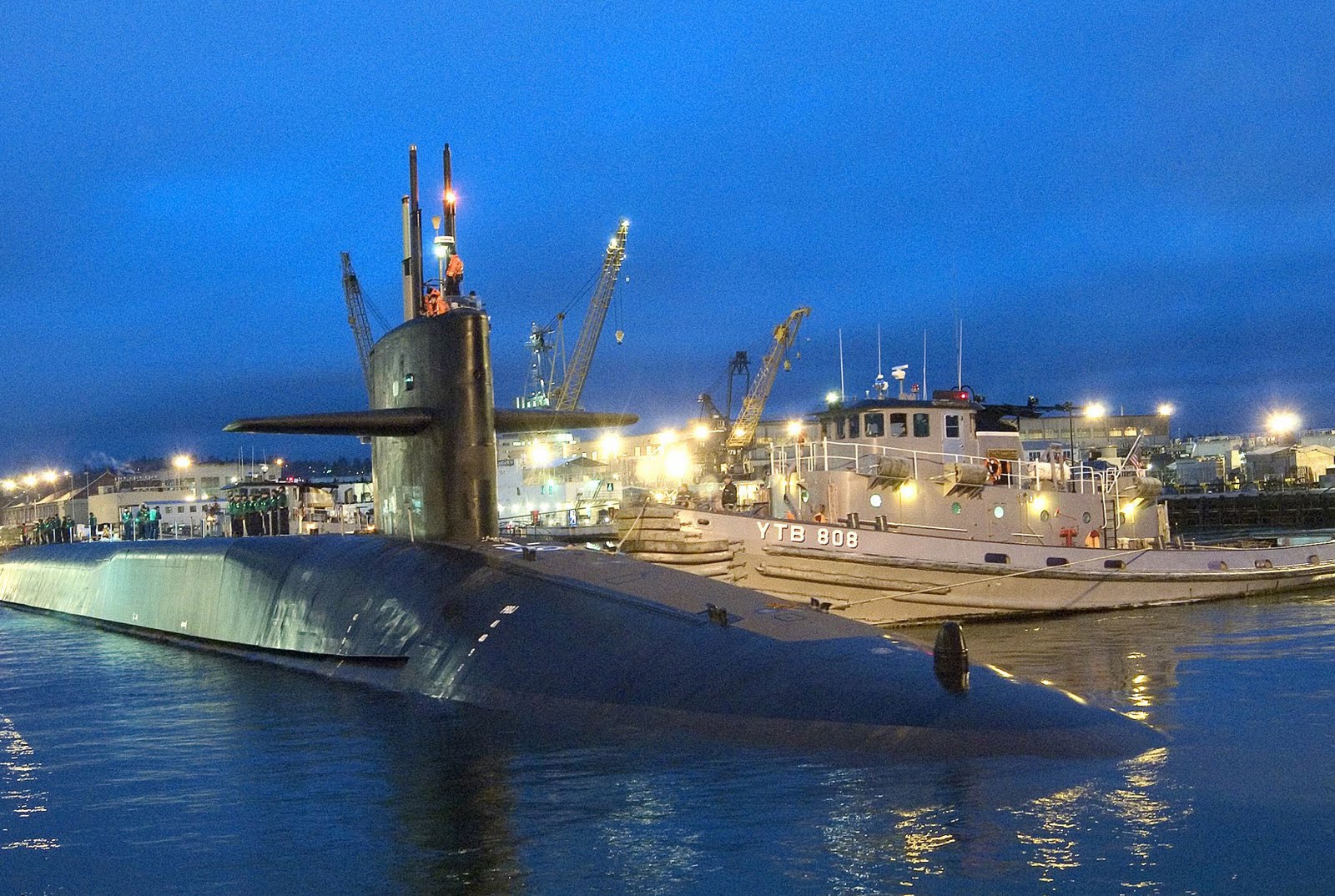
[USS Ohio]

On July 8 Time magazine’s Mark Thompson elaborated on the earlier report with language, including that of his title, “U.S. Missiles Deployed Near China Send a Message,” derived from the South China Morning Post piece, which Thompson claims contained information planted by “U.S. officials…on July 4, no less” [4] in a clear signal to the government in mainland China.

The Time journalist added details, though, not in the original story, replete with a good deal of editorializing that perhaps serves the same source he attributes the contents of the Hong Kong article to and for the same reason: As a shot across the bow to China.

His account of last week’s deployments included: “A new class of U.S. superweapon had suddenly surfaced nearby. It was an Ohio-class submarine, which for decades carried only nuclear missiles targeted against the Soviet Union, and then Russia.”

The U.S. has eighteen nuclear-powered Ohio class ballistic missile submarines, fourteen still armed with nuclear warhead-tipped Trident missiles and four which “hold up to 154 Tomahawk cruise missiles each, capable of hitting anything within 1,000 miles with non-nuclear warheads.”

“The 14 Trident-carrying subs are useful in the unlikely event of a nuclear Armageddon, and Russia remains their prime target. But the Tomahawk-outfitted quartet carries a weapon that the U.S. military has used repeatedly against targets in Afghanistan, Bosnia, Iraq and Sudan.” [5]

With the arrival of the USS Ohio in the Philippines, the USS Michigan in South Korea and the USS Florida “in the strategic Indian Ocean outpost of Diego Garcia” [6] on the same day, “the Chinese military awoke to find as many as 462 new Tomahawks deployed by the U.S. in its neighborhood.” [7]

The Time report also revealed that all four Ohio class Tomahawk-armed submarines were operationally deployed away from their home ports for the first time.

Thompson wrote that the coordinated actions were “part of a policy by the U.S. government to shift firepower from the Atlantic to the Pacific theater, which Washington sees as the military focus of the 21st century.”

Regarding the submarines still carrying Trident missiles, he rhetorically added, “Why 14 subs, as well as bombers and land-based missiles carrying nuclear weapons, are still required to deal with the Russian threat is a topic for another day.” [8]

All three journalists cited – Jing, Torode and Thompson – place the U.S. submarine deployments within a broader and also a more pressing context.

The South China Morning Post writer stated: “In policies drafted under then-president George W. Bush, a Republican, and continued by the administration of his successor, Democrat Barack Obama, the Pentagon is shifting 60 per cent of its 53 fast-attack [as distinct from ballistic and guided missile] submarines to the Pacific – a process that is now virtually complete.

“But the presence of the larger cruise-missile submarines shows that, at times, the US forward posture will be significantly larger.”

The USS Ohio, for example, “has been operating out of Guam for most of the last year, taking advantage of the island’s expanding facilities to extend its operations in the western Pacific.

“It is due to return soon, but the Florida and the Michigan are likely to remain in the region for many months yet, using Guam and possibly Diego Garcia for essential maintenance and crew changes.”

Additionally, “The presence of the Florida, based on the US east coast, appears to confirm the US is still routinely bringing submarines under the arctic ice cap to East Asia.” [9]

Just as the Pentagon is moving nuclear submarines under the northern polar ice cap to the Indian Ocean, so it has recently reached an “agreement [that] will allow troops to fly directly from the United States over the North Pole” to Afghanistan and “the region” by way of Kazakhstan, which borders China as well as Russia. [10]

The U.S. military “siege of China” is proceeding on several fronts, on land as well as under water and in Central as well as South and East Asia. But what primarily had been a policy of surveillance and probing China’s perimeter is now entering a new phase.

That the U.S. currently has over 60 per cent of the Tomahawk cruise missiles assigned to its Japan-based Seventh Fleet near China emphasizes the qualitative escalation of Washington’s show of strength vis-a-vis Beijing. One related to, as was seen above, a strategic shift of attack submarines nearer China and also to the crisis on the Korean Peninsula that was exacerbated by the sinking of a South Korean warship, the Cheonan, in March.

There has even been speculation that U.S. submarine deployments and other “messages” delivered to China of late were designed to pressure Beijing into taking a tougher stance toward North Korea over the Cheonan incident. What journalists have been referring to as messages would in an earlier age have been called saber-rattling and gunboat diplomacy.

U.S.-China relations sharply deteriorated this January when the Obama administration finalized an almost $6.5 billion arms sales package for Taiwan which includes 200 Patriot missiles. [11] An article on the subject in the New York Times on January 31 was titled, revealing enough, “U.S. Arms for Taiwan Send Beijing a Message.”

China suspended military ties with the U.S., and bad blood has persisted throughout the year, resulting in Secretary of Defense Robert Gates scrapping plans to visit Beijing early last month when he was effectively disinvited by Chinese officialdom on the prompting of the military.

The White House and the Pentagon have been sending a number of unequivocal – and increasingly provocative – messages to China this year.

The new U.S. administration signalled a confrontational approach early on. In May of 2009 Secretary of State Hillary Clinton, barely three months in her post, stated, “The Obama administration is working to improve deteriorating U.S. relations with a number of Latin American nations to counter growing Iranian, Chinese and Russian influence in the Western Hemisphere….” [12]

Later in the year then Director of National Intelligence (and retired admiral and former commander-in-chief of the Pacific Command) Dennis Blair released the latest quadrennial National Intelligence Strategy report which said “Russia, China, Iran, and North Korea pose the greatest challenges to the United States’ national interests. [13]

While Blair headed up the Pacific Command (PACOM) from 1999-2002, his role included overseeing a vast area of the planet that includes China (since the Ronald Reagan administration assigned it to that military command in 1983).

Arrogating the right to divide the entire world into military zones, areas of operation, has never been attempted by any other nation, any group of nations, not even all the nations of the world collectively (in the United Nations or otherwise). But the U.S. has and does do just that. It has even added two new Unified Combatant Commands – Northern Command and Africa Command – in recent years, in 2002 and 2007 respectively.


The Pacific Command is the oldest and largest of the six current regional commands (the others being the Africa, Northern, European, Central and Southern Commands), and was formed during the dawning of the Cold War in 1947. Its area of responsibility takes in over 50 per cent of the world – 105 million square miles – 36 nations and almost 60 per cent of the world’s population.

300,000 troops from all major branches of the U.S. armed forces – the Air Force, Army, Marine Corps and Navy – are assigned to it, 20 per cent of all active duty American service members.

Pacific Command is in charge of military defense treaties with Australia, Japan, New Zealand, the Philippines and South Korea.

The U.S. is also alone in assigning the world’s oceans and seas to naval commands. Washington has six naval fleets – the Fourth Fleet (the Caribbean, Central and South America) was reactivated in 2008 after being disbanded in 1950) – and just as Pacific Command is the largest unified, multi-service command, so the Seventh is the largest forward-deployed fleet, with 50-60 warships, 350 aircraft and as many as 60,000 Sailors and Marines at any given time. It is based in Japan and its area of responsibility includes over 50 million square miles of the (largely western) Pacific and Indian Oceans.

The U.S. also has eleven aircraft carriers, ten of them nuclear-powered and all eleven part of strike groups. [14] (China has no and Russia one carrier.)

The Time magazine article quoted from earlier mentioned that the deployment of four U.S. guided missile submarines to East Asia and the Indian Ocean is not the only development that China needs to be concerned about. The U.S. is simultaneously presiding over six-week biennial Rim of the Pacific (RIMPAC) military exercises in Hawaii with over 20,000 troops, 36 warships and submarines (25 American) and 180 planes and helicopters.

PEARL HARBOR- USS Benfold (DDG 65) arrives at Joint Base  Pearl Harbor-Hickam for RIMPAC 2010. RIMPAC is a biennial, multinational  exercise designed to strengthen regional partnerships and improve  multi-national interoperability

[RIMPAC 2010]

This year’s RIMPAC, which began on June 23 and is to be completed by the end of July, includes for the first time the participation of France, Colombia – with which the U.S. has recently concluded an agreement for the use of seven of its military bases [15] – and the Southeast Asia nations of Malaysia and Singapore. The other countries involved are Australia, Canada, Chile, Indonesia, Japan, the Netherlands, Peru, South Korea and Thailand. The five-week war games involve “missile exercises and the sinking of three abandoned vessels playing the role of enemy ships.” [16]

The combined task force commander for RIMPAC 2010 is commander of the U.S. Third Fleet, whose area of responsibility is approximately 50 million square miles of the eastern Pacific, Vice Admiral Richard Hunt, who stated, “This is the largest RIMPAC that we’ve had,” and one which “clearly focuses on maritime domain awareness dealing with expanded military operations across the complete spectrum of warfare.” [17]

Time’s Mark Thompson also wrote: “Closer to China, CARAT 2010 – for Cooperation Afloat Readiness and Training – just got underway [July 5] off Singapore. The operation involves 17,000 personnel and 73 ships from the U.S., Singapore, Bangladesh, Brunei, Cambodia, Indonesia, Malaysia, the Philippines and Thailand.

“China is absent from both exercises, and that’s no oversight.” [18]

This February Cobra Gold 2010, “the largest multinational military exercise in the world,” [19}, was launched in Thailand (separated from China by only one nation, either Laos or Myanmar) and as with all previous Cobra Gold war games was run by U.S. Pacific Command and the Royal Thai Supreme Command. Joining the U.S. and Thailand in this year's exercises, designed "to build interoperability between the United States and its Asia-Pacific regional partners," [20] were the armed forces of Japan, Indonesia, Singapore and, for the first time, South Korea.

From June 8-25 the latest U.S. Air Force-led Red Flag Alaska air maneuvers were held near the eastern Pacific. “The Red Flag exercises, conducted in four-to-six cycles a year by the 414th Combat Training Squadron of the 57th Wing, are very realistic aerial war games. The purpose is to train pilots from the U.S., NATO and other allied countries for real combat situations.” [21]

Over a thousand airmen from five nations – the U.S., Japan, South Korea, Romania and Belgium – assembled at Alaska’s Elmendorf and Eielson Air Force Bases for air combat training which “unites forces from all over the world.”

“South Korea, a country already accustomed to working with U.S. troops, is also in Alaska to strengthen the two nations’ ties after the sinking of a South Korean warship by a North Korean submarine.

“‘We have the American Air Force in Korea, and the coalition and the combined working environment is very important,’ said Lt. Hoon Min Kim, a member of South Korea’s air force. ‘And being able to perform under a combined environment is therefore essential as well.’” [22]

The incorporation of progressively more Asia-Pacific nations into what has been referred to as an Asian NATO is by no means directed solely at North Korea nor is it understood as such by officials in Beijing.

Participants in that arrangement, among them Australia, New Zealand, Singapore, South Korea and Mongolia, have troops serving under NATO in Afghanistan. Recently 140 new South Korean forces arrived at the Bagram Air Base in Afghanistan to reinforce a base in Parwan province recently subjected to repeated rocket attacks. Seoul’s troop strength in the war zone is now at 230.

This month the government of Singapore announced it will increase its soldiers in the NATO-led International Security Assistance Force to “a record 162, from 97 last year.”

“Next month, the Singapore Armed Forces (SAF) will send a 52-man unmanned aerial vehicle (UAV) team – its biggest deployment to Afghanistan – to Oruzgan [Uruzgan], one of two provinces where Singapore has troops.” [23]

Earlier this year NATO announced that Mongolia and South Korea have become the 45th and 46th nations to provide it with troops for the war in Afghanistan. Mongolia borders both China and Russia and is the object of intense efforts by the U.S. to increase military cooperation and integration. [24] On July 6 NATO’s Assistant Secretary General for Political Affairs and Security Policy Dirk Brengelmann paid a two-day visit to South Korea, where he stated, “Our security interests and security interests of countries like Korea coincide today more than ever.”

A news report of his visit paraphrased his comments as asserting that “The world’s biggest military alliance, NATO, is looking to increase cooperation with South Korea and other partners beyond Europe and North America,” and added that “Speaking of cooperation, Brengelmann noted NATO’s show of support for South Korea in light of the sinking of its warship Cheonan….The diplomat said some NATO members also serve on the U.N. Security Council and that the NATO members will try to ensure any Security Council action on the Cheonan sinking will represent their views expressed in the NATO statement.” [25]

Another country that shares borders with China and Russia, Kazakhstan, has allowed the U.S. and NATO transit and overflight rights for the Afghan war and last week the nation’s president, Nursultan Nazarbayev, signed a law permitting the Pentagon to ship “special cargo” – armored vehicles – through his country.

The U.S. and NATO have transited hundreds of thousands of troops through the Manas Air Base (now Transit Center at Manas) in Kyrgyzstan, which also borders China, since 2001 and in recent months troops have passed in and out from Afghanistan at the rate of 55,000 a month, 660,000 a year. [26] Washington has announced plans to open new training bases in Kyrgyzstan and Tajikistan, the second nation also adjoining China.

With Afghanistan and Pakistan, which also have borders with China, the U.S. and NATO have a military presence in five nations on China’s western flank and a foothold in Mongolia. The U.S. and NATO war in South Asia will enter its tenth year this autumn with no sign of Western military presence departing from China’s backyard.

The U.S. military remains ensconced in Japan and South Korea, has returned to the Philippines (including camps in Mindanao), is solidifying bilateral and multilateral military relations with practically all nations in Southeast Asia, and for the past five years has cultivated India as a military partner. [India is currently an observer at the RIMPAC exercises.) Japan, Taiwan and Australia are being integrated into a U.S.-designed regional and broader global interceptor missile system.

The U.S. is conducting regular military exercises, building military partnerships, stationing troops and opening bases around China's periphery, in addition to the positioning of warships, submarines and aircraft carriers in the waters off its coasts.

What alarms China most at the moment, though, is a proposed joint U.S.-South Korean military exercise in the Yellow Sea, enclosed by both Koreas to the east and China to the north and west.

China's Global Times recently quoted Xu Guangqian, military strategist at the People's Liberation Army's Academy of Military Sciences, issuing this warning: "China's position on the Yellow Sea issue demonstrates its resolution to safeguard national rights and interests. It also reflects that China is increasingly aware of the fact that its strategic space has confronted threats from other countries." [27]

China, which just concluded six days of naval drills of its own in the East China Sea, had more reason to be concerned when it was disclosed earlier this month that a U.S. aircraft carrier would join the maneuvers off its Yellow Sea coast.

On July 8 China renewed its opposition to the planned U.S.-South Korean war games, with Foreign Ministry spokesman Qin Gang telling reporters, “China has expressed its serious concerns with relevant parties. We are firmly opposed to foreign military vessels engaging in activities that undermine China’s security interests in the Yellow Sea or waters close to China.” [28]

An unsigned editorial in the Chinese Global Times of July 8 stated, “Beijing sees the joint exercise not only as being aimed at Pyongyang, but also as a direct threat to its territorial waters and coastline,” and blamed South Korean President Lee Myung-bak for worsening relations between the two nations:

“It is not known whether Lee had thought of China’s reaction when he announced in May the drill with the US.

“Did he foresee Chinese people’s anger? Or, did he intend to provoke the country on the other side of the Yellow Sea?

“It is a shame and a provocation on China’s doorstep.

“If a US aircraft carrier enters the Yellow Sea, it will mean a major setback to Seoul’s diplomacy, as hostility between the peoples of China and South Korea will probably escalate, which Beijing and Seoul have been working for years to avoid.” [29]

President Lee met with his American counterpart, Barack Obama, on the sidelines of the Group of Eight summit in Toronto late last month, during which a previous arrangement to transfer wartime command of South Korean forces to the nation in 2012 were postponed if not abandoned. In Obama’s words, “One of the topics that we discussed is that we have arrived at an agreement that the transition of operational control for alliance activities in the Korean peninsula will take place in 2015.” In the five-year interim “if war were to break out on the Korean peninsula the United States would assume operational command of South Korean forces.” [30]

If Washington is planning direct intervention on the Korean Peninsula as its military buildup in the region, including off China’s shores, might indicate, the words of former South Korean president Kim Young-Sam a decade ago are worth recalling. Two years after stepping down as head of state, Kim revealed to one of his nation’s main newspapers that he had intervened to prevent a second Korean war, that his government “stopped US President Bill Clinton from launching an air strike against North Korea’s nuclear facilities in June 1994.”

He initiated a last-minute phone conversation with the U.S. president which “saved the Korean peninsula from an imminent war,” as “The Clinton government was preparing a war” by deploying an aircraft carrier off the eastern coast of North Korea “close enough for its war planes to hit the North’s nuclear facilities in Yongbyon.”

Furthermore, Kim warned the U.S. ambassador in Seoul that “another war on the Korean peninsula would turn all of Korea into a bloodbath, killing between 10 and 20 million people and destroying South Korea’s prosperous economy.” [31]

Any catastrophic event on the Korean Peninsula, and war is the ultimate cataclysm, could lead to hundreds of thousands of North Korean refugees fleeing to Russia and millions to China.

The nearly nine-year war in Afghanistan being waged by the U.S. and NATO has led to an explosion of violence and destabilization in three nations flanking China: Afghanistan itself, Pakistan and Kyrgyzstan.

Also, since 2001 Afghanistan has become the world’s largest producer of opium and hashish, flooding the European and other drug markets. A forum entitled “Afghan Drug Production – A Challenge to the International Community” was held in Moscow a month ago.

A Russian report on the meeting stated “The situation around drug production in Afghanistan has gained a catastrophic character. Some 100,000 people died globally from Afghan drugs in 2009 alone. In all, Afghan-made opiates have claimed one million human lives in the past decade, and 16 million more ruined their health.” [32] 30,000 of the drug-related deaths occurred in Russia. The United Nations estimates that Afghanistan currently accounts for 92 per cent of world opium cultivation.

China and Russia are viewed as, if not challengers to U.S. global dominance, impediments to its further consolidation. And not in the military sphere but in the fields of economics, trade, energy and transportation. Destabilization of their neighborhoods and frontiers is one manner of limiting competition.

All means fair and foul are employed to eliminate obstacles to uncontested supremacy, and what the world’s sole military superpower (the term is President Obama’s from his Nobel Peace Prize acceptance speech) truly excels at is expanding its international military machine with an unflinching willingness to use it.

1) Global Times, July 8, 2010
2) South China Morning Post, July 4, 2010 http://www.scmp.com/portal/site/SCMP/menuitem.2c913216495213d5df646910cba0a0a0/?vgnextoid=6c48dbee25999210VgnVCM100000360a0a0aRCRD&vgnextfmt=teaser&ss=Asia+%26+World&s=News (Subscribers only)
3) Ibid
4) Time, July 8, 2010

http://www.time.com/time/nation/article/0,8599,2002378,00.html?xid=rss-topstories

5) Ibid
6) South China Morning Post, July 4, 2010
7) Time, July 8, 2010
8) Ibid
9) South China Morning Post, July 4, 2010
10) Kazakhstan: U.S., NATO Seek Military Outpost Between Russia And China
Stop NATO, April 14, 2010

http://rickrozoff.wordpress.com/2010/04/15/kazakhstan-u-s-nato-seek-military-outpost-between-russia-and-china

11) U.S.-China Military Tensions Grow
Stop NATO, January 19, 2010

http://rickrozoff.wordpress.com/2010/01/20/u-s-china-military-tensions-grow

12) Associated Press, May 1, 2009
13) Radio Free Europe/Radio Liberty, September 16, 2009
14) U.S. Consolidates Military Network In Asia-Pacific Region
April 28, 2010

http://rickrozoff.wordpress.com/2010/04/28/s-consolidates-military-network-in-asia-pacific-region

15) Colombia: U.S. Escalates War Plans In Latin America
Stop NATO, July 22, 2009

http://rickrozoff.wordpress.com/2009/09/01/colombia-u-s-escalates-war-plans-in-latin-america

16) Time, July 8, 2010
17) Navy Times, July 6, 2010
18) Ibid
19) American Forces Press Service, January 13, 2010
20) Ibid
21) http://en.wikipedia.org/wiki/Red_Flag_(USAF)
22) KTUU TV, June 24, 2010
23) AsiaOne, July 1, 2010
24) Mongolia: Pentagon Trojan Horse Wedged Between China And Russia
Stop NATO, March 31, 2010

http://rickrozoff.wordpress.com/2010/03/31/mongolia-pentagon-trojan-horse-wedged-between-china-and-russia

25) Yonhap News Agency, July 6, 2010
26) Kyrgyzstan And The Battle For Central Asia
Stop NATO, April 7, 2010

http://rickrozoff.wordpress.com/2010/04/08/kyrgyzstan-and-the-battle-for-central-asia

27) Global Times, July 6, 2010
28) Agence France-Presse, July 8, 2010
29) Global Times, July 8, 2010
30) Agence France-Presse, July 27, 2010
31) Agence France-Presse, May 24, 2000
32) Itar-Tass, June 9, 2010

.................................................................................................................................................
Isaiah 55:6Make search for the Lord while he is there, make prayer to him while he is near:Isaiah 55:7Let the sinner give up his way, and the evil-doer his purpose: and let him come back to the Lord, and he will have mercy on him, and to our God, for there is full forgiveness with him.
John 3:16
For God had such love for the world that he gave his only Son so that whoever has faith in him may not come to destruction but have eternal life

God bless you!

Sunday, July 4, 2010

The Third World War and the Inheritance of the New World

Are you standing on the Rock of Salvation?

We don't know if this information is true in whole or in part in relation to their origin.

What we do know is that the ruling elite is racist and has a plan to destroy civilization as we know it with the idea of creating the problem, get a reaction and they provide the solution to a humanity that desperately ask for something or someone to provide that solution and will be given through the person of the Antichrist, that the Bible was written in both the new and in the Old Testament.

As the elite can create a problem to which they are exposed? That has already been calculated long ago so there are shelters made for the entire leadership that is related with the dominant power in this world.

The elite is deceived by their god Satan, believing that for some reason are superior and are selected for survival, this is misleading because the idea of Satan is to kill, steal and destroy all and take them to hell, no respecter
people! Satanists are being used in your plan, that's all.

So we put this note to everyone that considers valuable to analyze it and investigate the matter.

.............................................................................................................................................

Source: http://projectcamelot.org

Historians tell us that the "Anglo-Saxon Mission" refers to the spread of Christianity in the 8th century. But over a thousand years later, there is now another, far more sinister meaning to the phrase. We recently received 11 pages of information from an insider who was physically present at a meeting of Senior Masons in the City of London in 2005. What was discussed is chilling to the bone.

I (Bill) did an audio interview with our source, an Englishman whose identity we have verified with all details known and confirmed. This man, like many we have spoken with, is no longer able to live with his conscience or to keep this information secret.

My original idea was to release a transcript of the interview, as we have done in the past. But the material it covers is so critical - and, for me, the missing pieces it provided were so important - that I've taken the step to present the information on video. The audio transcript with our source, who is not on the video, is available here.


What our source reports is this:

• There is a planned Third World War, which will be nuclear and biological. Our source believes that this is on track to be initiated within the next 18-24 months.

• It is planned to begin with a strike by Israel on Iran. Either Iran or China will be provoked into a nuclear response. After a brief nuclear exchange, there will be a ceasefire. The world will be thrown into fear and chaos - all carefully engineered.

• The extreme state of tension will be used to justify heavy social and military controls in all western first world nations. Plans are already in place for that.

• During the nuclear ceasefire, there is planned to be a covert release of biological weapons. These will initially be targeted against the Chinese. As our source chillingly told us, "China will catch a cold". Biological warfare will spread further, to the west. Infrastructure will be critically weakened.

• This is intended to be just the beginning. After this, a full nuclear exchange would be triggered: the "real" war, with widespread destruction and loss of life. Our source tells us that the planned population reduction through these combined means is 50%. He heard this figure stated in the meeting.

This horrific scenario has been planned for generations. The first two world wars were part of the set-up for this final apocalypse - as is the centralization of financial resources that was precipitated with the equally well-planned financial collapse of October 2008.

As if all this were not enough, our source speculates this is all set against the backdrop of a coming "geophysical event" - the same kind of event as was experienced by our ancestors approximately 11,500 years ago. If this event occurs - not necessarily expected in 2012, but sometime in the next decade - it would destroy civilization as we know it, dwarfing even the effects of a nuclear war.

I asked the question to our source: If there's an expected catastrophe, then why initiate a Third World War? His answer, for the first time to me, made terrible sense.

The real goal, he explained, is to set up the post-catastrophic world. To ensure that this "New World" [note the term] is the one the controllers want, totalitarian control structures need to be in place when the catastrophe occurs - with an excuse that the populace will accept and demand them. Martial law in the right, carefully chosen countries before the catastrophe occurs will enable the "right" people to survive and prosper in the post-catastrophic world, and the beginning of the next 11,500 year cycle. What may have been carefully planned on a covert global scale, for the last several generations, is nothing less than who will inherit the Earth.

Who are the "right" people? The white Caucasians. This may be why the name of this project is The Anglo-Saxon Mission. Hence the justification for the planned genocide of the Chinese people - so that the New World is inherited by "us", not "them".

Our source was not informed about the planned fate of the second and third world countries such as those in South America, Africa and Asia. But he presumes that these would be allowed to fend for themselves and probably not survive well - or maybe not at all. The totalitarian military governments of the western, white, people are set to be the inheritors.

This is a plan so evil, so racist, so diabolical, so huge, that it almost defies belief. But it all aligns with what many commentators, researchers and whistleblowing insiders have been identifying for some years now. For me personally, it's the clearest picture yet of why the world is the way it is, and why the secrets are protected so fiercely: it may be all about racial supremacy. The Fourth Reich is alive and well.

Click here for the witness audio transcript

Click here for Bill Ryan's presentation transcript

...........................................................................................................................
Isaiah 55:6
Make search for the Lord while he is there, make prayer to him while he is near:Isaiah 55:7Let the sinner give up his way, and the evil-doer his purpose: and let him come back to the Lord, and he will have mercy on him, and to our God, for there is full forgiveness with him.
John 3:16
For God had such love for the world that he gave his only Son so that whoever has faith in him may not come to destruction but have eternal life

God bless you!
Tuesday, June 29, 2010

Obama DOCTRINE: Congress Just Declared Preemptive WAR on Iran

Are you standing on the Rock of Salvation?

Source: http://www.activistpost.com

War with Iran has already been decided by the powers that be and the modern-day quasi-declaration happened last Thursday. Using the same legislative and propaganda playbook that led to the Iraq War, the U.S. Government has just officially declared War on Iran. Reuters reported “Congress on Thursday approved tough new unilateral sanctions aimed at squeezing Iran’s energy and banking sectors, which could also hurt companies from other countries doing business with Tehran. The House of Representatives passed the bill 408-8 and sent it to President Barack Obama for signing into law. The Senate had approved it 99-0 earlier in the day.”

Congress hasn’t officially voted for a Declaration of War since World War II. In modern times they use creative wording in bills that authorize the broad use of force across borders in the sweeping “War on Terror." The Bush Doctrine of preemptively attacking countries because they may pose a threat to America in the future was universally trashed by progressives, but is alive and well under Obama, the Prince of Peace, without one dissenting vote in the Senate. This authority is what the Obama Administration claims also gives them the legal argument to bomb sovereign countries like Pakistan.

This unilateral decision by the United States Congress comes on the heels of a 12-2 U.N. Security Council vote on June 8th to impose a “modest tightening of sanctions” against Iran. Of course, Russia and China have been assured that sanctions won't apply to their energy needs in order to secure their votes. After the vote President Obama asserted that, "these sanctions do not close the door on diplomacy."

However, the United States preempted this embargo vote in Congress by taking up an aggressive posture in tandem with Israel by deploying an Armada of Battleships to the Red Sea. There are now reports from the Israeli National News that, “The Israeli Air Force recently unloaded military equipment at a Saudi Arabia base, a semi-official Iranian news agency claimed Wednesday, while a large American force has massed in Azerbaijan, which is on the northwest border of Iran.”

Now, it seems that the United States is working overtime to sell their war plans to potential allies. CIA chief, Leon Panetta appeared on ABC’s This Week and announced that the Iranians, “have enough low-enriched uranium right now for two weapons. They do have to enrich it, fully, in order to get there. And we would estimate that if they made that decision, it would probably take a year to get there, probably another year to develop the kind of weapon delivery system in order to make that viable.”

While world leaders negotiate their piece of the Iranian pie in G8 negotiations, the multinational fear campaign has begun. Russian President Dmitry Medvedev said Sunday that a CIA warning that Iran has enough uranium to build two atomic bombs was "worrying," and criticized Tehran's secrecy over its nuclear program. Gathered at the G8 Summit in Ottawa, world leaders now “fully believe” and are “worried” that a preemptive attack by Israel on Iran is inevitable. Italian Prime Minister Silvio Berlusconi told reporters that “Iran is not guaranteeing a peaceful production of nuclear power [so] the members of the G8 are worried and believe absolutely that Israel will probably react preemptively.”

Enforcing an unprovoked embargo on a sovereign nation has been historically defined as an act of war. Unfortunately, very few of our elected officials know or understand history and therefore overwhelmingly voted for the new sanctions. Congressman Ron Paul (R-TX), an outspoken critic of Iran sanctions, was one of the eight house members to vote against the measure. Here is Ron Paul from a few months ago comparing sanctions to an Act of War while discussing this bill; H.R. 2194 Comprehensive Iran Sanctions, Accountability, and Divestment Act of 2010.


The Bush-Obama Doctrine is the rule of tyrants. Clearly it looks like Israel and America are determined to preemptively strike Iran even though Iran has always maintained that their nuclear program is for peaceful energy production only. America has once again engaged in an Act of War on a sovereign nation that has not harmed, or even threatened to harm her. Iran's biggest crime appears to be sitting on a sea of crude at a time when oil-thirsty Neo-cons, who penned the Doctrine, rule the world. The coming war with Iran will not be pretty.


...........................................................................................................................
Isaiah 55:6
Make search for the Lord while he is there, make prayer to him while he is near:Isaiah 55:7Let the sinner give up his way, and the evil-doer his purpose: and let him come back to the Lord, and he will have mercy on him, and to our God, for there is full forgiveness with him.
John 3:16
For God had such love for the world that he gave his only Son so that whoever has faith in him may not come to destruction but have eternal life

God bless you!

Thursday, June 17, 2010

Kyrgyzstan: Bloodstained Geopolitical Chessboard

Are you standing on the Rock of Salvation?

From: http://rickrozoff.wordpress.com/

Events in a remote, landlocked and agrarian nation of slightly over five million people have become the center of world attention.A week of violence which first erupted in Kyrgyzstan’s second largest city, Osh, in the south of the country, has resulted in the deaths of at least 120 civilians and in over 1,700 being injured.More than 100,000 ethnic Uzbeks have fled Osh and the nearby city of Jalal-Abad (Jalalabad) and three-quarters of those have reportedly crossed the border into Uzbekistan.A report of June 14 estimated that 50,000 were stranded on the Kyrgyz side of the border without food, water and other necessities. [1]

Witnesses describe attacks by gangs of ethnic Kyrgyz against Uzbeks with reports of government armed forces siding with the assailants.

The following day the United Nations High Commissioner for Refugees (UNHCR) estimated that 275,000 people in total had fled the violence-torn area.

On June 14 the deputy head of the International Committee of the Red Cross in Osh, Severine Chappaz, was quoted as warning: “We are extremely concerned about the nature of the violence that is taking place and are getting reports of severe brutality, with an intent to kill and harm. The authorities are completely overwhelmed, as are the emergency services.

“The armed and security forces must do everything they can to protect the vulnerable and ensure that hospitals, ambulances, medical staff and other emergency services are not attacked.” [2]

The government of neighboring Uzbekistan had registered 45,000 refugees by June 14, with an estimated 55,000 more on the way. United Nations representatives said that over 100,000 people had fled Kyrgyzstan, mainly ethnic Uzbeks to Uzbekistan, by June 15.

According to a news account of the preceding day, “Kyrgyz mobs burned Uzbek villages and slaughtered residents on Sunday, sending more than 75,000 Uzbeks fleeing across the border into Uzbekistan. Ethnic Uzbeks in a besieged neighbourhood of the Kyrgyz city of Osh said gangs, aided by the military, were carrying out genocide, burning residents out of their homes and shooting them as they fled.” [3]

Accounts of hundreds of corpses in the streets and a hundred bodies buried in one unmarked grave have also surfaced.

The government of acting (unelected) president Roza Otunbayeva (the nation’s first ambassador to the United States in the early 1990s) called up all reservists under 50 years of age and issued shoot-to-kill orders in the affected areas.

On June 13 Russia deployed a reinforced battalion of as many as 650 airborne troops to the Kant Air Base in Kyrgyzstan where Russian air force units have been stationed since 2003. (Russia had also sent 150 paratroopers to the base after April’s overthrow of Otunbayeva’s predecessor Kurmanbek Bakiyev.)

On June 15 two chartered planes repatriated 195 Chinese nationals from Kyrgyzstan, flying them into the adjoining Xinjiang Uygur Autonomous Region. By the following day almost 1,000 Chinese had been rescued.

India, Pakistan, Turkey and Russia also evacuated citizens from the nation.

Both the Collective Security Treaty Organization consisting of Russia, Kyrgyzstan and five other former Soviet republics and the Shanghai Cooperation Organization of China, Russia and all Central Asian nations except for Turkmenistan have addressed the Kyrgyz crisis.

This month’s bloody rampages were an aftershock of those following the overthrow of President Bakiyev in early April [4], following which at least 80 people were killed and over 1,500 injured. At that time Russian President Dmitry Medvedev warned that “Kyrgyzstan is on the threshold of a civil war.” [5]

The current violence in Kyrgyzstan, which may prove to be terminal for the 19-year-old Central Asian state, is a continuation and inevitable culmination of that of April. The latter in turn occurred five years after the overthrow of the government of President Askar Akayev by a coalition of opposition forces led by Bakiyev, Otunbayeva and Felix Kulov, a coup that was widely celebrated in the West at the time as the high point of an inexorable wave of what were characterized as “color” and “rainbow” revolutions in the former Soviet Union and beyond.

Two months after the 2005 putsch in Kyrgyzstan, U.S. President George W. Bush was in the Georgian capital of Tbilisi where he crowed: “In recent months, the world has marvelled at the hopeful changes taking place from Baghdad to Beirut to Bishkek [the Kyrgyz capital]. But before there was a purple revolution in Iraq, or an orange revolution in Ukraine, a cedar revolution in Lebanon, there was a rose revolution in Georgia.” [6]

Bush’s statement, his transparent endorsement of the “color revolution” model of extending U.S. domination over former Soviet states and Middle Eastern nations, has been echoed by former U.S. national security advisor and self-ordained geostrategic chess master Zbigniew Brzezinski who was quoted by a Kyrgyz news source as saying, “I believe revolutions in Georgia, Ukraine and Kyrgyzstan were a sincere and snap expression of the political will.” [7]

The ringleaders of the 2005 violent, unconstitutional takeover in Kyrgyzstan divided up top government posts, with Bakiyev becoming president, Kulov prime minister and Otunbayeva acting foreign minister.

Regarding the “hopeful changes” that Bush and Brzezinski acclaimed, it is worth recalling that the only two elected presidents in the young nation’s history are wanted men forced into exile. The “shock therapy” privatization of the nation’s economy in the 1990s, as disruptive as it was abrupt, laid the groundwork for subsequent destabilization, but that buildings are flammable is no defense for an arsonist.

The Pentagon opened the Manas Air Base (also named the Ganci Air Base by the U.S.) near the Kyrgyz capital in December of 2001, two months after the invasion of Afghanistan to support military operations in that nation.

The base, since last summer called the Transit Center at Manas, has seen hundreds of thousands of U.S. and North Atlantic Treaty Organization combat troops pass through in the interim.

Washington’s civilian hit man for the expanding war in South Asia, which is the largest and most deadly war in the world currently with hundreds of thousands of troops involved and millions of civilians displaced on both sides of the Afghanistan-Pakistan border, is Richard Holbrooke, appointed Special Representative for Afghanistan and Pakistan after the new administration was installed in Washington in January of last year.

This February he visited Kyrgyzstan and the three other former Soviet Central Asian republics it borders: Kazakhstan, Tajikistan and Uzbekistan. Shortly after returning to Washington, “Holbrooke said that the United States would soon renew an agreement to use the Manas airbase, where he said 35,000 US troops were transiting each month on their way in and out of Afghanistan.” [8]

Afterward Major John Redfield of U.S. Central Command (CENTCOM) said that during the next month, this March, 50,000 American troops had passed through the Kyrgyz base to and from Afghanistan, and the new commander of U.S. operations at Manas with the 376th Air Expeditionary Wing, Colonel Dwight Sones, recently disclosed that “55,000 servicemen were airlifted to Afghanistan via Manas in May.” [9]

That is, 20,000 more troops a month over a three-month period and at a rate of almost two-thirds of a million annually.

In February of 2009 Kyrgyzstan’s parliament voted 78-1 to close the U.S. air base at Manas and President Kurmanbek Bakiyev signed a decree to do so.

The U.S. was given “180 days to withdraw some 1,200 personnel, aircraft and other equipment.” [10] The following month Kyrgyz deputies also voted to expel military personnel from Australia, Denmark, Italy, Spain, South Korea, the Netherlands, Norway, New Zealand, Poland, Turkey and France, all nations providing troops for NATO’s International Assistance Security Force (ISAF) in Afghanistan.

Popular internal opposition to the presence of U.S. and NATO forces in the country had been mounting as the Afghan war dragged on interminably and especially after the killing of a Kyrgyz civilian, Alexander Ivanov, by an American soldier in December of 2006 and the dumping of 80 tons of fuel into the atmosphere by U.S. military planes the year before. Many Kyrgyz also fear that the use of the air base at Manas for an attack against Iran could pull their nation into a second and far more catastrophic armed conflict.

The situation was made worse in August of 2008 when “A major depot with weapons and ammunition” was “found in a private house in Bishkek rented by U.S. nationals in an operation by Kyrgyz police….According to law enforcement officers, six heavy machine guns, 26 Kalashnikov assault-rifles, almost 3,000 cartridges for them, two Winchester rifles, four machine gun barrels, two grenade launches, four sniper guns, six Beretta pistols, 10,000 cartridges for a nine-millimetre pistol, 478 12-millimetre cartridges, 1,000 tracer cartridges and 123 empty magazines were found there.

“Police said the house belonged to a Kyrgyz national, who had rented it to US nationals.

“They also said there were several staffers of the U.S. Embassy to Kyrgyzstan having diplomatic immunity, as well as ten U.S. military in the house during the search.” [11]

The U.S. claimed it had government permission to store the above-described arsenal in a private residence.

Last year Russia negotiated an extension of its military presence at the Kant Air Base for 49 years and offered the Kyrgyz government a $2 billion loan.

In June of 2009 the outgoing U.S. commander at Manas, Colonel Christopher Bence, “said the facility had started to wind down operations” and “has started to shut down and will close by mid-August.” [12] He added “that over the past year alone 189,000 troops from 20 countries had moved to and out of Afghanistan via the Manas base” [13] and that “we have started shipping equipment and supplies to other locations and those shipments should be finished by August 18.” [14] (Recall that 55,000 Western troops passed through the base last month alone.)

However, earlier in the month President Barack Obama sent a personal appeal to his Kyrgyz counterpart urging him to reverse the decision to expel U.S. military personnel, some 1,300 permanently assigned to the base, and “Kyrgyzstan showed more flexibility on the matter after receiving the letter….” [15]

On July 2 President Bakiyev signed an agreement to extend U.S. military presence at Manas after Washington offered $180 million a year for the use of the base, thereafter referred to as a transit center. “Rent for the land is $60 million as compared to $17.4 million Kyrgyzstan received for hosting the airbase.” [16] In early August U.S. Defense Secretary Robert Gates sent a letter to President Bakiyev commending him for overriding the near-unanimous decision by his country’s parliament, including his own party’s deputies, to close down Pentagon operations, instead simply renaming the Manas Air Base while activity there was scheduled to increase.

A Russian report on the transition, a change more formal than substantive, said that “Many experts on Central Asian politics speculated that Bishkek was simply angling for more money and was not intending to close the base.” [17]

It is in part a struggle over the $180 million in U.S. funds as well as the $2 billion in Russian aid pledged in February of last year that precipitated April’s phase two of the so-called Tulip Revolution.

Complementing the new arrangement with the Pentagon, last December Kyrgyzstan authorized the establishment of a NATO representative office in its capital. A spokesman for the nation’s parliament said at the time, “Until recently, the NATO representative office was located in the city of Astana, Kazakhstan.” Kyrgyz Defense Minister Bakyt Kalyev stated: “NATO recently started to pay special attention to Central Asia in light of the deteriorating situation in Afghanistan.

“The relocation of NATO’s official to the territory of Kyrgyzstan will proceed as part of the Partnership for Peace Program. One of the key reasons behind the transfer of the office from Astana to Bishkek is the fact that the territory of the republic houses the International Transit Center.” [18]

Richard Holbrooke met with the Kyrgyz president this February to solidify plans for the Manas base.

This March it was announced that the Pentagon is to set up a “counter-terrorism” special forces training base in Kyrgyzstan.

General David Petraeus, chief of U.S. Central Command, visited Kyrgyzstan and met with its president in March. “The visit [came] a day after US diplomats confirmed Washington would provide US$5.5 million to the Kyrgyz government toward the construction of a counter-terrorism training center in southern Kyrgyzstan.” [19]

The day after this April’s uprising began a Pentagon spokesman said of the operations at Manas that “Our support to Afghanistan continues and has not been seriously affected, and we are hopeful that we will be able to resume full operations soon.” [20]

A week later the government of then interim prime minister Roza Otunbayeva extended the lease for the Manas base another year. The next month a record number of Western troops passed through Kyrgyzstan in support of the war in Afghanistan.

On June 10 Robert Simmons, NATO’s Special Representative for the Caucasus and Central Asia, arrived in the Kyrgyz capital to further military cooperation with the new regime. “Simmons visits Kyrgyzstan each time the existence of the Transit Center at Manas, called Manas Air Base until 2009, is threatened. The high-ranking diplomat’s first visit to Bishkek took place in May 2005.

“Then, Washington was concerned about the base’s future after the March 2005 Tulip Revolution in Kyrgyzstan that overthrew President Askar Akayev. Simmons paid another visit to the republic in February 2009, or two weeks before President Kurmanbek Bakiyev announced his intention to close the base. This time, Simmons met with Roza Otunbayeva, head of the Kyrgyz interim government, and acting Finance Minister Temir Sariyev, who is responsible for budget income.” [21]

In addition, “Kyrgyz media say Washington has paid $15 million in first-quarter lease payments ahead of schedule and promises to transfer the second tranche to the cash-strapped Kyrgyz budget soon.” [22]

On June 8 EurasiaNet, “operated by the Central Eurasia Project of the Open Society Institute,” [23] ran a feature entitled “Pentagon Looks to Plant New Facilities in Central Asia,” which included these excerpts:

“The Pentagon is preparing to embark on a mini-building boom in Central Asia. A recently posted sources-sought survey indicates the US military wants to be involved in strategic construction projects in all five Central Asian states, including Turkmenistan and Uzbekistan.

“According to the notice posted on the Federal Business Opportunities (FBO) website in mid-May, the US Army Corps of Engineers wants to hear from respondents interested in participating in ‘large-scale ground-up design-build construction projects in the following Central South Asian States (CASA): Kazakhstan; Kyrgyzstan; Tajikistan; Turkmenistan; and Uzbekistan.’

“’We anticipate two different projects in Kyrgyzstan. Both are estimated to be in the $5 million to $10 million dollar range.’” [24]

On June 14 Pentagon spokesman Colonel David Lapan told CNN that “the refueling and troop transport operations at the U.S. transit base in Manas, Kyrgyzstan, continue ‘unabated’ by ethnic riots in the southern part of the country….Refueling operations had been halted while the United States negotiated new fuel contracts with the interim government…but late last week refueling started again.” [25]

An analysis recently appeared on the website of the German international radio broadcaster Deutsche Welle which provided insightful background information regarding the current crisis in Kyrgyzstan:

“Bakiyev’s installation as president in 2005 with US backing may have provided Washington with a friendly government with whom to do business with but it also gave the US a significant foothold in a country that some strategists believe is paramount to its plans for regional dominance.”

“The inclusion of Kyrgyzstan and three other central Asian states in NATO’s Partnership for Peace program in 1994 was seen as a major step toward increasing US military presence in the region which eventually led to the US base at Manas, outside Bishkek in the north, being established.”

“While Manas remains a key hub for US operations in Afghanistan, it is also used as a NATO base – a situation which angers and concerns Russia which fears the eastern enlargement of its former Cold War opponent, putting Kyrgyzstan at the center of a power struggle for regional influence….Russia is also concerned about the possibility of being encircled by NATO member states should the alliance go ahead with its provocative eastern enlargement.”

“The Chinese see increasing US influence as not only a threat to its plans for Eurasia, which along with promoting its emerging market policy also includes energy security and supply, but also a threat to the People’s Republic itself….Beijing [is] more concerned that the porous nature of the border is allowing US intelligence agencies to run covert destabilizing operations into the strategically vital and politically fragile [Xinjiang] province. Beijing believes the flow of people across the border gives US operations a perfect cover.” [26]

Small and seemingly insignificant Kyrgyzstan is the country most vital to U.S. and NATO for the reinforcement and escalation of the war in Afghanistan, even more than Pakistan where NATO supply convoys are routinely attacked and destroyed.

The transit center in the country is the only base the Pentagon has in Central Asia after it was evicted from the Karshi-Khanabad Air Base in Uzbekistan five years ago.

Kyrgyzstan is Washington’s military outpost in a region where the interests of several major nations – Russia, China, India, Pakistan and Iran among them – converge. U.S. stratagems in the nation, whether attempts at the maintenance of a permanent military presence or rotating governments through the use of standard “regime change” maneuvers, will have consequences far more serious than what the status of the diminutive and impoverished Central Asian nation may otherwise indicate.

1) Itar-Tass, June 14, 2010
2) UzReport, June 14, 2010
3) Daily Times (Pakistan)/Agencies, June 14, 2010
4) Kyrgyzstan And The Battle For Central Asia
Stop NATO, April 7, 2010

http://rickrozoff.wordpress.com/2010/04/08/kyrgyzstan-and-the-battle-for-central-asia

5) Russian Information Agency Novosti, April 14, 2010
6) Agence France-Presse, May 11, 2005
7) 24.kg, March 27, 2008
8) Agence France-Presse, March 4, 2010
9) Interfax, June 15, 2010
10) Russian Information Agency Novosti, February 20, 2009
11) Itar-Tass, March 6, 2009
12) Reuters, June 15, 2009
13) Voice of Russia, June 17, 2009
14) Stars and Stripes, June 16, 2009
15) Reuters, June 11, 2009
16) Russia Today, June 23, 2009
17) Ibid
18) Interfax, December 29, 2009
19) Radio Free Europe/Radio Liberty, March 10, 2010
20) U.S. Air Forces in Europe
American Forces Press Service
April 8, 2010
21) Nezavisimaya Gazeta, June 15, 2010
22) Ibid
23) http://www.eurasianet.org/node/14733
24) EurasiaNet, June 8, 2010

http://www.eurasianet.org/node/61241

25) CNN, June 14, 2010
26) Nick Amies, Kyrgyzstan unrest adds new edge to global powers’ regional
rivalry
Deutsche Welle, June 14, 2010

...............................................................................................................
Isaiah 55:6
Make search for the Lord while he is there, make prayer to him while he is near:Isaiah 55:7Let the sinner give up his way, and the evil-doer his purpose: and let him come back to the Lord, and he will have mercy on him, and to our God, for there is full forgiveness with him.
John 3:16For God had such love for the world that he gave his only Son so that whoever has faith in him may not come to destruction but have eternal life

God bless you!