Showing posts with label Wars. Show all posts

Wednesday, August 4, 2010

Veteran Intelligence Professionals for Sanity: Israel May Bomb Iran This Month

Are you standing on the Rock of Salvation?

Source: http://theintelhub.com

MEMORANDUM FOR: The President

FROM: Veteran Intelligence Professionals for Sanity (VIPS)

We write to alert you to the likelihood that Israel will attack Iran as early as this month. This would likely lead to a wider war.

Israel’s leaders would calculate that once the battle is joined, it will be politically untenable for you to give anything less than unstinting support to Israel, no matter how the war started, and that U.S. troops and weaponry would flow freely. Wider war could eventually result in destruction of the state of Israel.


This can be stopped, but only if you move quickly to pre-empt an Israeli attack by publicly condemning such a move before it happens.

We believe that comments by senior American officials, you included, reflect misplaced trust in Israeli Prime Minister [Benjamin] Netanyahu.

Actually, the phrasing itself can be revealing, as when CIA Director Panetta implied cavalierly that Washington leaves it up to the Israelis to decide whether and when to attack Iran, and how much “room” to give to the diplomatic effort.

On June 27, Panetta casually told ABC’s Jake Tapper, “I think they are willing to give us the room to be able to try to change Iran diplomatically … as opposed to changing them militarily.”


Similarly, the tone you struck referring to Netanyahu and yourself in your July 7 interview with Israeli TV was distinctly out of tune with decades of unfortunate history with Israeli leaders.

“Neither of us try to surprise each other,” you said, “and that approach is one that I think Prime Minister Netanyahu is committed to.” You may wish to ask Vice President Biden to remind you of the kind of surprises he has encountered in Israel.

Blindsiding has long been an arrow in Israel’s quiver. During the emerging Middle East crisis in the spring of 1967, some of us witnessed closely a flood of Israeli surprises and deception, as Netanyahu’s predecessors feigned fear of an imminent Arab attack as justification for starting a war to seize and occupy Arab territories.

We had long since concluded that Israel had been exaggerating the Arab “threat” — well before 1982 when former Israeli Prime Minister Menachem Begin publicly confessed:

“In June 1967, we had a choice. The Egyptian army concentrations in the Sinai approaches do not prove that [Egyptian President] Nasser was really about to attack us. We must be honest with ourselves. We decided to attack him.”

Israel had, in fact, prepared well militarily and also mounted provocations against its neighbors, in order to provoke a response that could be used to justify expansion of its borders.

Given this record, one would be well advised to greet with appropriate skepticism any private assurances Netanyahu may have given you that Israel would not surprise you with an attack on Iran.

Netanyahu’s Calculations

Netanyahu believes he holds the high cards, largely because of the strong support he enjoys in our Congress and our strongly pro-Israel media. He reads your reluctance even to mention in controversial bilateral issues publicly during his recent visit as affirmation that he is in the catbird seat in the relationship.

During election years in the U.S. (including mid-terms), Israeli leaders are particularly confident of the power they and the Likud Lobby enjoy on the American political scene.

This prime minister learned well from Menachem Begin and Ariel Sharon.

Netanyahu’s attitude comes through in a video taped nine years ago and shown on Israeli TV, in which he bragged about how he deceived President Clinton into believing he (Netanyahu) was helping implement the Oslo accords when he was actually destroying them.

The tape displays a contemptuous attitude toward — and wonderment at — an America so easily influenced by Israel. Netanyahu says:

“America is something that can be easily moved. Moved in the right direction. … They won’t get in our way … Eighty percent of the Americans support us. It’s absurd.”

Israeli columnist Gideon Levy wrote that the video shows Netanyahu to be “a con artist … who thinks that Washington is in his pocket and that he can pull the wool over its eyes,” adding that such behavior “does not change over the years.”

As mentioned above, Netanyahu has had instructive role models.

None other than Gen. Brent Scowcroft told the Financial Times that former Israeli Prime Minister Ariel Sharon had George W. Bush “mesmerized;” that “Sharon just has him “wrapped around his little finger.”

(Scowcroft was promptly relieved of his duties as chair of the prestigious President’s Foreign Intelligence Advisory Board and told never again to darken the White House doorstep.)

If further proof of American political support for Netanyahu were needed, it was manifest when Senators McCain, Lieberman, and Graham visited Israel during the second week of July.

Lieberman asserted that there is wide support in Congress for using all means to keep Iran from becoming a nuclear power, including “through military actions if we must.” Graham was equally explicit: “The Congress has Israel’s back,” he said.

More recently, 47 House Republicans have signed onto H.R. 1553 declaring “support for Israel’s right to use all means necessary to confront and eliminate nuclear threats posed by Iran … including the use of military force.”

The power of the Likud Lobby, especially in an election year, facilitates Netanyahu’s attempts to convince those few of his colleagues who need convincing that there may never be a more auspicious time to bring about “regime change” in Tehran.

And, as we hope your advisers have told you, regime change, not Iranian nuclear weapons, is Israel’s primary concern.

If Israel’s professed fear that one or two nuclear weapons in Iran’s arsenal would be a game changer, one would have expected Israeli leaders to jump up and down with glee at the possibility of seeing half of Iran’s low enriched uranium shipped abroad.

Instead, they dismissed as a “trick” the tripartite deal, brokered by Turkey and Brazil with your personal encouragement, that would ship half of Iran’s low enriched uranium outside Tehran’s control.

The National Intelligence Estimate

The Israelis have been looking on intently as the U.S. intelligence community attempts to update, in a “Memorandum to Holders,” the NIE of November 2007 on Iran’s nuclear program. It is worth recalling a couple of that Estimate’s key judgments:

“We judge with high confidence that in fall of 2003 Tehran halted its nuclear weapons program. … We assess with moderate confidence Tehran has not restarted its nuclear program as of mid-2007, but we do not know whether it currently intends to develop nuclear weapons …”

Earlier this year, public congressional testimony by former Director of National Intelligence Dennis Blair (February 1 & 2) and Defense Intelligence Agency Director Gen. Ronald Burgess with Vice Chairman of the Joint Chiefs Gen. James Cartwright (April 14) did not alter those key judgments.

Blair and others continued to underscore the intelligence community’s agnosticism on one key point: as Blair put it earlier this year, “We do not know if Iran will eventually decide to build a nuclear weapon.”

The media have reported off-the-cuff comments by Panetta and by you, with a darker appraisal — with you telling Israeli TV “… all indicators are that they [the Iranians] are in fact pursuing a nuclear weapon;” and Panetta telling ABC, “I think they continue to work on designs in that area [of weaponization].”

Panetta hastened to add, though, that in Tehran, “There is a continuing debate right now as to whether or not they ought to proceed with the bomb.”

Israel probably believes it must give more weight to the official testimony of Blair, Burgess, and Cartwright, which dovetail with the earlier NIE, and the Israelis are afraid that the long-delayed Memorandum to Holders of the 2007 NIE will essentially affirm that Estimate’s key judgments.

Our sources tell us that an honest Memorandum to Holders is likely to do precisely that, and that they suspect that the several-months-long delay means intelligence judgments are being “fixed” around the policy — as was the case before the attack on Iraq.

One War Prevented

The key judgments of the November 2007 NIE shoved an iron rod into the wheel spokes of the Dick Cheney-led juggernaut rolling toward war on Iran. The NIE infuriated Israel leaders eager to attack before President Bush and Vice President Cheney left office. This time, Netanyahu fears that issuance of an honest Memorandum might have similar effect.

Bottom line: more incentive for Israel to pre-empt such an Estimate by striking Iran sooner rather than later.

Last week’s announcement that U.S. officials will meet next month with Iranian counterparts to resume talks on ways to arrange higher enrichment of Iranian low enriched uranium for Tehran’s medical research reactor was welcome news to all but the Israeli leaders.

In addition, Iran reportedly has said it would be prepared to halt enrichment to 20 percent (the level needed for the medical research reactor), and has made it clear that it looks forward to the resumption of talks.

Again, an agreement that would send a large portion of Iran’s LEU abroad would, at a minimum, hinder progress toward nuclear weapons, should Iran decide to develop them. But it would also greatly weaken Israel’s scariest rationale for an attack on Iran.

Bottom line: with the talks on what Israel’s leaders earlier labeled a “trick” now scheduled to resume in September, incentive builds in Tel Aviv for the Israelis to attack before any such agreement can be reached.

We’ll say it again: the objective is regime change. Creating synthetic fear of Iranian nuclear weapons is simply the best way to “justify” bringing about regime change. Worked well for Iraq, no?

Another War in Need of Prevention

A strong public statement by you, personally warning Israel not to attack Iran would most probably head off such an Israeli move. Follow-up might include dispatching Adm. Mullen to Tel Aviv with military-to-military instructions to Israel: Don’t Even Think of It.

In the wake of the 2007 NIE, President Bush overruled Vice President Cheney and sent Adm. Mullen to Israel to impart that hard message. A much-relieved Mullen arrived home that spring sure of step and grateful that he had dodged the likelihood of being on the end of a Cheney-inspired order for him to send U.S. forces into war with Iran.

This time around, Mullen returned with sweaty palms from a visit to Israel in February 2010. Ever since, he has been worrying aloud that Israel might mousetrap the U.S. into war with Iran, while adding the obligatory assurance that the Pentagon does have an attack plan for Iran, if needed.

In contrast to his experience in 2008, though, Mullen seemed troubled that Israel’s leaders did not take his warnings seriously.

While in Israel, Mullen insisted publicly that an attack on Iran would be “a big, big, big problem for all of us, and I worry a great deal about the unintended consequences.”

After his return, at a Pentagon press conference on Feb. 22 Mullen drove home the same point. After reciting the usual boilerplate about Iran being “on the path to achieve nuclear weaponization” and its “desire to dominate its neighbors,” he included the following in his prepared remarks:

“For now, the diplomatic and the economic levers of international power are and ought to be the levers first pulled. Indeed, I would hope they are always and consistently pulled. No strike, however effective, will be, in and of itself, decisive.”

Unlike younger generals — David Petraeus, for example — Adm. Mullen served in the Vietnam War. That experience is probably what prompts asides like this: “I would remind everyone of an essential truth: War is bloody and uneven. It’s messy and ugly and incredibly wasteful …”

Although the immediate context for that remark was Afghanistan, Mullen has underscored time and again that war with Iran would be a far larger disaster. Those with a modicum of familiarity with the military, strategic and economic equities at stake know he is right.

Other Steps

In 2008, after Mullen read the Israelis the riot act, they put their pre-emptive plans for Iran aside. With that mission accomplished, Mullen gave serious thought to ways to prevent any unintended (or, for that matter, deliberately provoked) incidents in the crowded Persian Gulf that could lead to wider hostilities.

Mullen sent up an interesting trial balloon at a July 2, 2008, press conference, when he indicated that military-to-military dialogue could “add to a better understanding” between the U.S. and Iran. But nothing more was heard of this overture, probably because Cheney ordered him to drop it.

It was a good idea — still is. The danger of a U.S.-Iranian confrontation in the crowded Persian Gulf has not been addressed, and should be. Establishment of a direct communications link between top military officials in Washington and Tehran would reduce the danger of an accident, miscalculation, or covert, false-flag attack.

In our view, that should be done immediately — particularly since recently introduced sanctions assert a right to inspect Iranian ships. The naval commander of the Iranian Revolutionary Guards reportedly has threatened “a response in the Persian Gulf and the Strait of Hormuz,” if anyone tries to inspect Iranian ships in international waters.

Another safety valve would result from successful negotiation of the kind of bilateral “incidents-at-sea” protocol that was concluded with the Russians in 1972 during a period of relatively high tension.

With only interim nobodies at the helm of the intelligence community, you may wish to consider knocking some heads together yourself and insisting that it finish an honest Memorandum to Holders of the 2007 NIE by mid-August — recording any dissents, as necessary.

Sadly, our former colleagues tell us that politicization of intelligence analysis did not end with the departure of Bush and Cheney…and that the problem is acute even at the State Department’s Bureau of Intelligence and Research, which in the past has done some of the best professional, objective, tell-it-like-it-is analysis.

Pundits, Think Tanks: Missing the Point

As you may have noticed, most of page one of Sunday’s Washington Post Outlook section was given to an article titled, “A Nuclear Iran: Would America Strike to Prevent It? — Imagining Obama’s Response to an Iranian Missile Crisis.”

Page five was dominated by the rest of the article, under the title “Who will blink first when Iran is on the brink?”

A page-wide photo of a missile rolling past Iranian dignitaries on a reviewing stand (reminiscent of the familiar parades on Red Square) is aimed at the centerfold of the Outlook section, as if poised to blow it to smithereens.

Typically, the authors address the Iranian “threat” as though it endangers the U.S., even though Secretary Clinton has stated publicly that this is not the case. They write that one option for the U.S. is “the lonely, unpopular path of taking military action lacking allied consensus.” O Tempora, O Mores!

In less than a decade, wars of aggression have become nothing more than lonely, unpopular paths.

What is perhaps most remarkable, though, is that the word Israel is nowhere to be found in this very long article. Similar think pieces, including some from relatively progressive think tanks, also address these issues as though they were simply bilateral U.S.-Iranian problems, with little or no attention to Israel.

Guns of August?

The stakes could hardly be higher. Letting slip the dogs of war would have immense repercussions. Again, we hope that Adm. Mullen and others have given you comprehensive briefings on them.

Netanyahu would be taking a fateful gamble by attacking Iran, with high risk to everyone involved. The worst, but conceivable case, has Netanyahu playing — unintentionally — Dr. Kevorkian to the state of Israel.

Even if the U.S. were to be sucked into a war provoked by Israel, there is absolutely no guarantee that the war would come out well.

Were the U.S. to suffer significant casualties, and were Americans to become aware that such losses came about because of exaggerated Israeli claims of a nuclear threat from Iran, Israel could lose much of its high standing in the United States.

There could even be an upsurge in anti-Semitism, as Americans conclude that officials with dual loyalties in Congress and the executive branch threw our troops into a war provoked, on false pretenses, by Likudniks for their own narrow purposes.

We do not have a sense that major players in Tel Aviv or in Washington are sufficiently sensitive to these critical factors.

You are in position to prevent this unfortunate, but likely chain reaction. We allow for the possibility that Israeli military action might not lead to a major regional war, but we consider the chances of that much less than even.

Footnote: VIPS Experience

We VIPS have found ourselves in this position before. We prepared our first Memorandum for the President on the afternoon of February 5, 2003 after Colin Powell’s speech at the UN.

We had been watching how our profession was being corrupted into serving up faux intelligence that was later criticized (correctly) as “uncorroborated, contradicted, and nonexistent” — adjectives used by former Senate Intelligence Committee chair Jay Rockefeller after a five-year investigation by his committee.

As Powell spoke, we decided collectively that the responsible thing to do was to try to warn the President before he acted on misguided advice to attack Iraq. Unlike Powell, we did not claim that our analysis was “irrefutable and undeniable.” We did conclude with this warning:

“After watching Secretary Powell today, we are convinced that you would be well served if you widened the discussion … beyond the circle of those advisers clearly bent on a war for which we see no compelling reason and from which we believe the unintended consequences are likely to be catastrophic.”

http://www.afterdowningstreet.org/downloads/vipstwelve.pdf

We take no satisfaction at having gotten it right on Iraq. Others with claim to more immediate expertise on Iraq were issuing similar warnings. But we were kept well away from the wagons circled by Bush and Cheney.

Sadly, your own Vice President, who was then chair of the Senate Foreign Affairs Committee, was among the most assiduous in blocking opportunities for dissenting voices to be heard. This is part of what brought on the worst foreign policy disaster in our nation’s history.

We now believe that we may also be right on (and right on the cusp of) another impending catastrophe of even wider scope — Iran — on which another President, you, are not getting good advice from your closed circle of advisers.

They are probably telling you that, since you have privately counseled Prime Minister Netanyahu against attacking Iran, he will not do it. This could simply be the familiar syndrome of telling the President what they believe he wants to hear.

Quiz them; tell them others believe them to be dead wrong on Netanyahu. The only positive here is that you — only you — can prevent an Israeli attack on Iran.

Steering Group, Veteran Intelligence Professionals for Sanity (VIPS)

Ray Close, Directorate of Operations, Near East Division, CIA (26 years)

Phil Giraldi, Directorate of Operations, CIA (20 years)

Larry Johnson, Directorate of Intelligence, CIA; Department of State, Department of Defense consultant (24 years)

W. Patrick Lang, Col., USA, Special Forces (ret.); Senior Executive Service: Defense Intelligence Officer for Middle East/South Asia, Director of HUMINT Collection, Defense Intelligence Agency (30 years)

Ray McGovern, US Army Intelligence Officer, Directorate of Intelligence, CIA (30 years)

Coleen Rowley, Special Agent and Minneapolis Division Counsel, FBI (24 years)

Ann Wright, Col., US Army Reserve (ret.), (29 years); Foreign Service Officer, Department of State (16 years)


..........................................................................................................................

Isaiah 55:6Make search for the Lord while he is there, make prayer to him while he is near:Isaiah 55:7Let the sinner give up his way, and the evil-doer his purpose: and let him come back to the Lord, and he will have mercy on him, and to our God, for there is full forgiveness with him.
John 3:16
For God had such love for the world that he gave his only Son so that whoever has faith in him may not come to destruction but have eternal life

God bless you!

Sunday, July 25, 2010

Resolution Green-Lighting Israeli Strikes on Iran Introduced by House Republicans

Are you standing on the Rock of Salvation?

Source: http://www.informationclearinghouse.info

"Huffington Post" -- Republicans in the House of Representatives have introduced a measure that would green-light an Israeli bombing campaign against Iran. The resolution, H.Res. 1553 (in full below), provides explicit support for military strikes against Iran, stating that Congress supports Israel's use of "all means necessary" against Iran "including the use of military force". US military leaders have warned that strikes could be catastrophic to US national security interests and could engulf the Middle East in a "calamitous" regional war.

Nearly a third of House Republicans have signed onto the resolution, which has been publicly discussed and circulated by its lead sponsor, Rep. Louie Gohmert (R-TX), for months. The National Iranian American Council is leading calls to oppose the measure, urging those concerned to demand that House Republican Leader John Boehner denounce the resolution.

The introduction of the measure coincides with a pattern of renewed calls for military strikes that have escalated since President Obama signed "crippling" Congressional Iran sanctions into law. Neoconservatives who were instrumental in orchestrating the Iraq War, such as Bill Kristol, and Reuel Marc Gerecht, have led the stepped up calls for military action.

Hawkish former Bush Administration official John Bolton recently laid out the game plan to prod Israel into attacking Iran, arguing that outsiders can "create broad support" for a strike by framing it as an issue of Israel's right to self defense. Supporters for military strikes, Bolton says, should "defend the specific tactic of pre-emptive attacks" against Iran. He urges that Congress can "make it clear" that it supports such strikes and that "having visible congressional support in place at the outset will reassure the Israeli government, which is legitimately concerned about Mr. Obama's likely negative reaction to such an attack."

In spite of enthusiasm from the neocons, top US military leaders have warned of the many dangers of military strikes against Iran. Defense Secretary Robert Gates has argued, "Another war in the Middle East is the last thing we need. In fact, I believe it would be disastrous on a number of levels." Admiral Mike Mullen, Chairman of the Joint Chiefs has expressed his own serious reservations about an attack, stating, "Iran getting a nuclear weapon would be incredibly destabilizing. Attacking them would also create the same kind of outcome. In an area that's so unstable right now, we just don't need more of that." General David Petraeus has warned that a strike on Iran would be utilized by the Iranian government to unite it's otherwise divided populace.

Simulations have been conducted over the past year to assess the outcome of a preemptive military strike against Iran. One such simulation, by the Brookings Institution's Saban Center, found that strikes would draw the US into the conflict that would engulf the region into war, and would enable Iran to use the attacks as an opportunity to unite the Iranian people and dismantle its opposition. The simulation also found that the strikes could not destroy Iran's nuclear program but merely set it back a few years.

An Oxford Research Group report released recently reinforced those findings and also warned that an Israeli attack would be disastrous and would be unlikely to stop Iran's nuclear program. Instead, the report concluded attacks could convince Iran to withdraw from the international Nuclear Non-proliferation Treaty and to aggressively seek to develop nuclear weapons.

Iranian activists have urged that even raising the specter of war undercuts the opposition in Iran. "The mere fact that Obama didn't make military threats made the Green Movement possible," noted Akbar Ganji. "A military attack would destroy all of that."


Iran Resolution -

....................................................................................................................................
Isaiah 55:6
Make search for the Lord while he is there, make prayer to him while he is near:Isaiah 55:7Let the sinner give up his way, and the evil-doer his purpose: and let him come back to the Lord, and he will have mercy on him, and to our God, for there is full forgiveness with him.
John 3:16
For God had such love for the world that he gave his only Son so that whoever has faith in him may not come to destruction but have eternal life

God bless you!

Saturday, July 24, 2010

War on Terror or War of Terror?

Are you standing on the Rock of Salvation?

Source: http://www.counterpunch.org

Critical evidence from the British government and other sources suggest that the “War on Terror” has actually destabilized the Middle East and increased the terror threat throughout the globe. The former head of Britain’s MI5 – Baroness Manningham-Buller – finds that the Iraq war has dramatically contributed to the growing terror danger as directed against the United Kingdom and its citizens.

Britain has been forced to double the budget devoted to investigating terrorist plots following the 2003 invasion.
An official British inquiry into the proposed invasion warned of just such an increase in the terror threat. This means that the destabilizing affects of Western attacks were predicted in advance of attacks that were seen as illegal under international law (as British Deputy Prime Minister Nick Clegg recently conceded) .

Buller’s confession is an admission that the war in Iraq has further inflamed anti-U.S. and anti-U.K. sentiment. When considering it along other critical studies, it looks as if the war has contributed to a greater hostility toward British foreign policy more generally among the majority of Middle Easterners, and among British nationals more specifically (Buller is most concerned with the latter group). She concludes that “a whole generation of young people” have been “radicalized’ by what is perceived as an attack on Islam.

The Blair administration, Buller states, conceded that the war increased the terror threat at home: the budget increases for anti-terror operations were “unheard of, certainly unheard of today, but he (Blair) and the Treasury and the chancellor accepted that because I was able to demonstrate the scale of the problem that we were confronted by.” The growing threat to Britain seems all the more plausible in light of the 7/7 2005 terrorist bombings in London, which killed more than 50 civilians and were motivated by anger at the British invasion of Iraq.

Buller concedes what should be known by most in the U.S. and U.K. today – the terror threat has grown in the wake of the Iraq invasion, despite the fact that Iraq posed no real national security threat to the West. Buller admits that MI5 had refused to contribute to the intelligence comprising the British government’s dossier against Iraq’s “WMD threat” in 2002. The reason is clear enough: there was “no credible evidence” that Iraq was linked to the 9/11 attacks, and Saddam Hussein was “unlikely” to support any attacks against the U.S. or U.K. unless his regime’s survival was threatened. These conclusions were shared with the Bush administration at the time, and promptly ignored by a U.S. administration whose members had been set on going to war for more than 10 years.

Buller also discusses a point well known among critics of U.S. foreign policy on the left: the invasion of Iraq has actually served as one of the best recruiters for Osama bin Laden, al Qaeda, and loosely affiliated Islamist terror groups. As Buller describes with regards to U.S.-U.K. actions in Iraq: “Arguably, we gave Osama bin Laden his Iraqi jihad.” In short, those throughout the Muslim world see the U.S.-allied occupation as motivated by imperial ambitions for oil; they see the torture and abuses in which American and British troops are responsible, and they are reacting critically. Targeting of U.S. and allied forces has become far more common now than it was prior to 9/11.

Buller’s MI5 based conclusions are not the first time it’s been conceded that the “War on Terror” actually increases the global terror threat. Terrorism experts Peter Bergen and Paul Cruickshank found through their own statistical analysis that the 2003 invasion was accompanied by an “Iraq Effect” in which terrorist attacks escalated dramatically from 2003 to 2006 (the time period when the study was conducted). More specifically, their report finds that: “the rate of terrorist attacks around the world by jihadist groups and the rate of fatalities in those attacks increased dramatically after the invasion of Iraq. Globally there was a 607 percent rise in the average yearly incidence of attacks (28.3 attacks per year before and 199.8 after) and a 237 percent rise in the average fatality rate (from 501 to 1,689 deaths per year). A large part of this rise occurred in Iraq, which accounts for fully half of the global total of jihadist terrorist attacks in the post-Iraq War period.

But even excluding Iraq, the average yearly number of jihadist terrorist attacks and resulting fatalities still rose sharply around the world by 265 percent and 58 percent respectively.” Subsequent empirical studies of the decline of violence in Iraq after 2007 demonstrated that the reduction came about, not because of the success of the "surge" in promoting humanitarianism, but because the ethnic cleansing in cities like Baghdad had essentially succeeded (with the help of U.S. troops disarming Sunni communities in the name of "counter-insurgency"), and with the Shia militias winning the civil war against Iraq's Sunnis (for more, see: http://www.juancole.com/2008/07/social-history-of-surge.html and dimaggio02272009.html). In short, violence declined because there were fewer people to kill following the successful ethnic cleansing.

Additional journalistic investigation finds that the policy of torture and mistreatment at Guantanamo, in Iraq, and in Afghanistan (often directed against those whose terrorist ties were questionable to non-existent, but were nonetheless picked up in blanket raids in Afghanistan and Iraq) led to a further intensification of anti-U.S. sentiment in the Muslim world. As McClatchy Newspapers concluded in an eight month investigation in 11 countries, U.S. detainees were often kept “on the basis of flimsy or fabricated evidence…McClatchy interviewed 66 released detainees, more than a dozen local officials in Afghanistan, and U.S. officials with intimate knowledge of the detention program...This unprecedented compilation shows that most of the 66 were low level Taliban grunts, innocent Afghan villagers, or ordinary criminals. At least seven had been working for the U.S. backed Afghan government and had no ties to militants…many of the detainees posed no danger to the U.S. or its allies”.

Through its investigations, McClatchy found that “prisoner mistreatment became a regular feature in cellblocks and interrogation rooms at Bagram and Kandahar air bases, the two main way stations in Afghanistan en route to Guantanamo…the investigation found that top Bush administration officials knew within months of opening the Guantanamo detention center that many of the prisoners there weren’t ‘the worst of the worst,’” as “it was obvious [from military administrators] that at least a third of the population didn’t belong there.”

American soldiers were often gullible in that they accepted “false reports passed along by informants and officials looking to settle old grudges in Afghanistan, a nation that had experienced more than two decades of occupation and civil war before U.S. troops arrived". The lack of connections of many detainees to any terror operations looks especially tragic in hindsight, considering that the torture visited upon these individuals contributed to their radicalization against the United States. As McClatchy reports, “U.S. detention policies fueled support for extremist Islamist groups. For some detainees who went home far more militant than when they arrived, Guantanamo became a school for jihad.”

The above evidence strongly suggests that the U.S. and U.K. primarily play a destabilizing role throughout the world, rather than fighting terrorism and ensuring world order out of chaos. Global public opinion polls have long found that most throughout the world view the U.S. as one of the primary threats to global security, rather than the protector of world order. These revelations are likely to elude many Americans, as the evidence above is not widely disseminated in the U.S. press. American journalists have long been content to uncritically repeat statements from liberal and conservative political officials (typically accompanied with no evidence) that the “War on Terror” must continue in order to keep America, its allies, and the Middle East “safe.” In reality, though, the U.S. and U.K. are not fighting a War on Terror, but a War of Terror.

Anthony DiMaggio is the editor of media-ocracy (www.media-ocracy.com), a daily online magazine devoted to the study of media, public opinion, and current events. He is the author of When Media Goes to War (2010) and Mass Media, Mass Propaganda (2008). He can be reached at: mediaocracy@gmail.com

............................................................................................................................................
Isaiah 55:6
Make search for the Lord while he is there, make prayer to him while he is near:Isaiah 55:7Let the sinner give up his way, and the evil-doer his purpose: and let him come back to the Lord, and he will have mercy on him, and to our God, for there is full forgiveness with him.
John 3:16For God had such love for the world that he gave his only Son so that whoever has faith in him may not come to destruction but have eternal life

God bless you!

Sunday, July 11, 2010

Pentagon Provokes New Crisis With China

Are you standing on the Rock of Salvation?

Source: http://rickrozoff.wordpress.com

Three news features appearing earlier this week highlight tensions between the United States and the People’s Republic of China that, at least in relation to the language used to describe them, would have seemed unimaginable even a few months ago and are evocative more of the Korean War era than of any time since the entente cordiale initiated by the Richard Nixon-Mao Zedong meeting in Beijing in 1972.

To indicate the seriousness of the matter, the stories are from Global Times, a daily newspaper published in conjunction with the People’s Daily, official press organ of the ruling Communist Party of China, and Time, preeminent American weekly news magazine. Both accounts use as their point of departure and source of key information a July 4 report in Hong Kong’s major English-language daily.

On July 6 writer Li Jing penned a news article for Global Times called “US subs reach Asian ports: report,” which detailed the following recent developments:

“Three of the largest submarines of the US Seventh Fleet surfaced in Asia-Pacific ports last week, the South China Morning Post reported Monday [July 5]. The appearance of the USS Michigan in Pusan, South Korea, the USS Ohio in Subic Bay, the Philippines, and the USS Florida in the strategic Indian Ocean outpost of Diego Garcia was a show of force not seen since the end of the Cold War, the paper said, adding that the position of those three ports looks like a siege of China.” [1]

The piece from the Hong Kong newspaper cited was entitled “US submarines emerge in show of military might: Message unlikely to be lost on Beijing as 3 vessels turn up in Asian ports,” and was in fact dated July 4.

The author, South China Morning Post Asia correspondent Greg Torode, described the simultaneous arrival of three “Ohio-class submarines” equipped with “a vast quantity of Tomahawk cruise missiles” as a reflection of “the trend of escalating submarine activity in East Asia….” [2]

He further added this noteworthy data: “Between them, the three submarines can carry 462 Tomahawks, boosting by an estimated 60 per cent-plus the potential Tomahawk strike force of the entire Japanese-based Seventh Fleet – the core projection of US military power in East Asia.”

The author quotes without identifying his name or nation a veteran Asian military attache with reported close ties to both Chinese and U.S. military officials: “460-odd Tomahawks is a huge amount of potential firepower in anybody’s language.

“It is another sign that the US is determined to not just maintain its military dominance in Asia, but to be seen doing so…that is a message for Beijing and for everybody else, whether you are a US ally or a nation sitting on the fence.” [3]

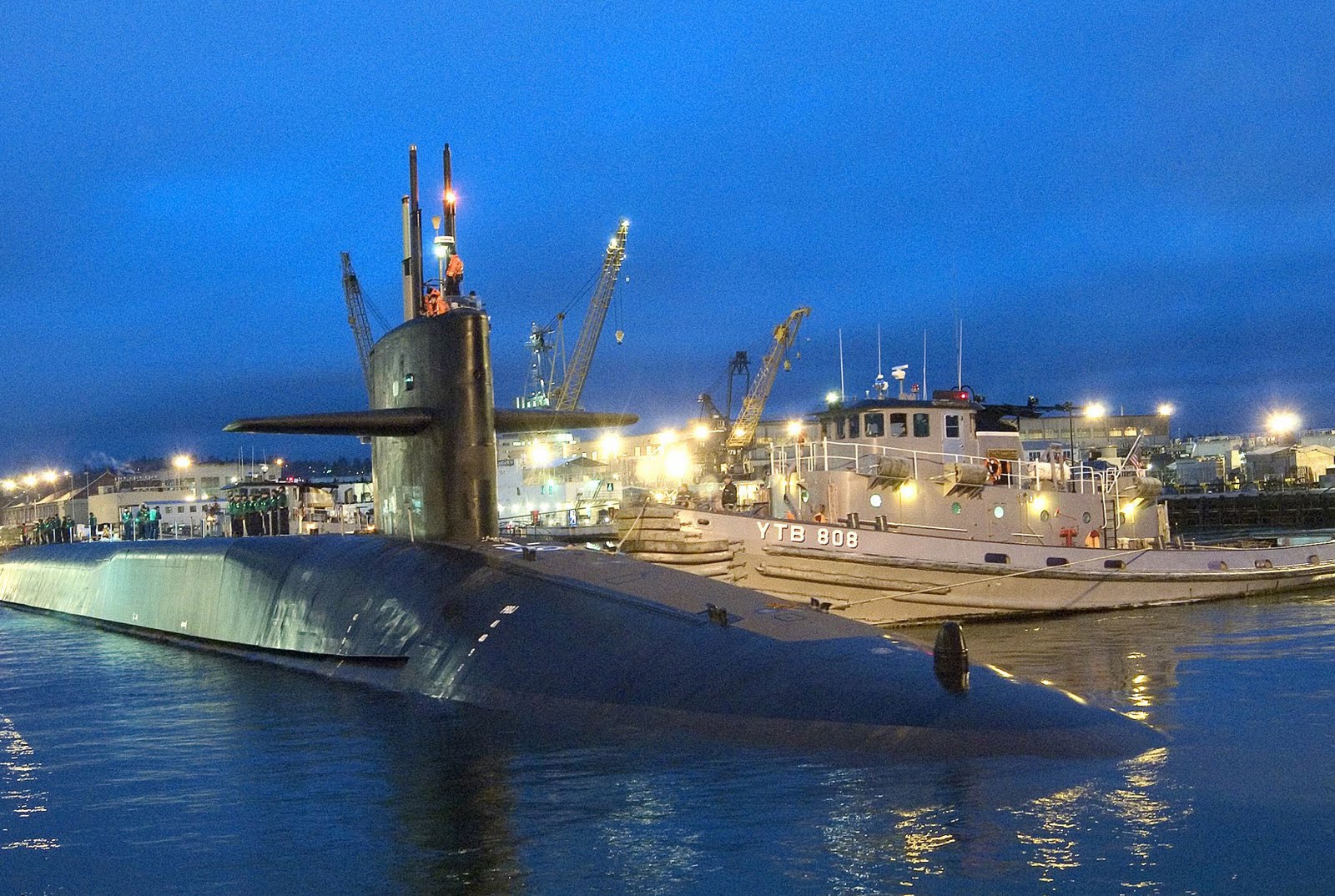
[USS Ohio]

On July 8 Time magazine’s Mark Thompson elaborated on the earlier report with language, including that of his title, “U.S. Missiles Deployed Near China Send a Message,” derived from the South China Morning Post piece, which Thompson claims contained information planted by “U.S. officials…on July 4, no less” [4] in a clear signal to the government in mainland China.

The Time journalist added details, though, not in the original story, replete with a good deal of editorializing that perhaps serves the same source he attributes the contents of the Hong Kong article to and for the same reason: As a shot across the bow to China.

His account of last week’s deployments included: “A new class of U.S. superweapon had suddenly surfaced nearby. It was an Ohio-class submarine, which for decades carried only nuclear missiles targeted against the Soviet Union, and then Russia.”

The U.S. has eighteen nuclear-powered Ohio class ballistic missile submarines, fourteen still armed with nuclear warhead-tipped Trident missiles and four which “hold up to 154 Tomahawk cruise missiles each, capable of hitting anything within 1,000 miles with non-nuclear warheads.”

“The 14 Trident-carrying subs are useful in the unlikely event of a nuclear Armageddon, and Russia remains their prime target. But the Tomahawk-outfitted quartet carries a weapon that the U.S. military has used repeatedly against targets in Afghanistan, Bosnia, Iraq and Sudan.” [5]

With the arrival of the USS Ohio in the Philippines, the USS Michigan in South Korea and the USS Florida “in the strategic Indian Ocean outpost of Diego Garcia” [6] on the same day, “the Chinese military awoke to find as many as 462 new Tomahawks deployed by the U.S. in its neighborhood.” [7]

The Time report also revealed that all four Ohio class Tomahawk-armed submarines were operationally deployed away from their home ports for the first time.

Thompson wrote that the coordinated actions were “part of a policy by the U.S. government to shift firepower from the Atlantic to the Pacific theater, which Washington sees as the military focus of the 21st century.”

Regarding the submarines still carrying Trident missiles, he rhetorically added, “Why 14 subs, as well as bombers and land-based missiles carrying nuclear weapons, are still required to deal with the Russian threat is a topic for another day.” [8]

All three journalists cited – Jing, Torode and Thompson – place the U.S. submarine deployments within a broader and also a more pressing context.

The South China Morning Post writer stated: “In policies drafted under then-president George W. Bush, a Republican, and continued by the administration of his successor, Democrat Barack Obama, the Pentagon is shifting 60 per cent of its 53 fast-attack [as distinct from ballistic and guided missile] submarines to the Pacific – a process that is now virtually complete.

“But the presence of the larger cruise-missile submarines shows that, at times, the US forward posture will be significantly larger.”

The USS Ohio, for example, “has been operating out of Guam for most of the last year, taking advantage of the island’s expanding facilities to extend its operations in the western Pacific.

“It is due to return soon, but the Florida and the Michigan are likely to remain in the region for many months yet, using Guam and possibly Diego Garcia for essential maintenance and crew changes.”

Additionally, “The presence of the Florida, based on the US east coast, appears to confirm the US is still routinely bringing submarines under the arctic ice cap to East Asia.” [9]

Just as the Pentagon is moving nuclear submarines under the northern polar ice cap to the Indian Ocean, so it has recently reached an “agreement [that] will allow troops to fly directly from the United States over the North Pole” to Afghanistan and “the region” by way of Kazakhstan, which borders China as well as Russia. [10]

The U.S. military “siege of China” is proceeding on several fronts, on land as well as under water and in Central as well as South and East Asia. But what primarily had been a policy of surveillance and probing China’s perimeter is now entering a new phase.

That the U.S. currently has over 60 per cent of the Tomahawk cruise missiles assigned to its Japan-based Seventh Fleet near China emphasizes the qualitative escalation of Washington’s show of strength vis-a-vis Beijing. One related to, as was seen above, a strategic shift of attack submarines nearer China and also to the crisis on the Korean Peninsula that was exacerbated by the sinking of a South Korean warship, the Cheonan, in March.

There has even been speculation that U.S. submarine deployments and other “messages” delivered to China of late were designed to pressure Beijing into taking a tougher stance toward North Korea over the Cheonan incident. What journalists have been referring to as messages would in an earlier age have been called saber-rattling and gunboat diplomacy.

U.S.-China relations sharply deteriorated this January when the Obama administration finalized an almost $6.5 billion arms sales package for Taiwan which includes 200 Patriot missiles. [11] An article on the subject in the New York Times on January 31 was titled, revealing enough, “U.S. Arms for Taiwan Send Beijing a Message.”

China suspended military ties with the U.S., and bad blood has persisted throughout the year, resulting in Secretary of Defense Robert Gates scrapping plans to visit Beijing early last month when he was effectively disinvited by Chinese officialdom on the prompting of the military.

The White House and the Pentagon have been sending a number of unequivocal – and increasingly provocative – messages to China this year.

The new U.S. administration signalled a confrontational approach early on. In May of 2009 Secretary of State Hillary Clinton, barely three months in her post, stated, “The Obama administration is working to improve deteriorating U.S. relations with a number of Latin American nations to counter growing Iranian, Chinese and Russian influence in the Western Hemisphere….” [12]

Later in the year then Director of National Intelligence (and retired admiral and former commander-in-chief of the Pacific Command) Dennis Blair released the latest quadrennial National Intelligence Strategy report which said “Russia, China, Iran, and North Korea pose the greatest challenges to the United States’ national interests. [13]

While Blair headed up the Pacific Command (PACOM) from 1999-2002, his role included overseeing a vast area of the planet that includes China (since the Ronald Reagan administration assigned it to that military command in 1983).

Arrogating the right to divide the entire world into military zones, areas of operation, has never been attempted by any other nation, any group of nations, not even all the nations of the world collectively (in the United Nations or otherwise). But the U.S. has and does do just that. It has even added two new Unified Combatant Commands – Northern Command and Africa Command – in recent years, in 2002 and 2007 respectively.


The Pacific Command is the oldest and largest of the six current regional commands (the others being the Africa, Northern, European, Central and Southern Commands), and was formed during the dawning of the Cold War in 1947. Its area of responsibility takes in over 50 per cent of the world – 105 million square miles – 36 nations and almost 60 per cent of the world’s population.

300,000 troops from all major branches of the U.S. armed forces – the Air Force, Army, Marine Corps and Navy – are assigned to it, 20 per cent of all active duty American service members.

Pacific Command is in charge of military defense treaties with Australia, Japan, New Zealand, the Philippines and South Korea.

The U.S. is also alone in assigning the world’s oceans and seas to naval commands. Washington has six naval fleets – the Fourth Fleet (the Caribbean, Central and South America) was reactivated in 2008 after being disbanded in 1950) – and just as Pacific Command is the largest unified, multi-service command, so the Seventh is the largest forward-deployed fleet, with 50-60 warships, 350 aircraft and as many as 60,000 Sailors and Marines at any given time. It is based in Japan and its area of responsibility includes over 50 million square miles of the (largely western) Pacific and Indian Oceans.

The U.S. also has eleven aircraft carriers, ten of them nuclear-powered and all eleven part of strike groups. [14] (China has no and Russia one carrier.)

The Time magazine article quoted from earlier mentioned that the deployment of four U.S. guided missile submarines to East Asia and the Indian Ocean is not the only development that China needs to be concerned about. The U.S. is simultaneously presiding over six-week biennial Rim of the Pacific (RIMPAC) military exercises in Hawaii with over 20,000 troops, 36 warships and submarines (25 American) and 180 planes and helicopters.

PEARL HARBOR- USS Benfold (DDG 65) arrives at Joint Base  Pearl Harbor-Hickam for RIMPAC 2010. RIMPAC is a biennial, multinational  exercise designed to strengthen regional partnerships and improve  multi-national interoperability

[RIMPAC 2010]

This year’s RIMPAC, which began on June 23 and is to be completed by the end of July, includes for the first time the participation of France, Colombia – with which the U.S. has recently concluded an agreement for the use of seven of its military bases [15] – and the Southeast Asia nations of Malaysia and Singapore. The other countries involved are Australia, Canada, Chile, Indonesia, Japan, the Netherlands, Peru, South Korea and Thailand. The five-week war games involve “missile exercises and the sinking of three abandoned vessels playing the role of enemy ships.” [16]

The combined task force commander for RIMPAC 2010 is commander of the U.S. Third Fleet, whose area of responsibility is approximately 50 million square miles of the eastern Pacific, Vice Admiral Richard Hunt, who stated, “This is the largest RIMPAC that we’ve had,” and one which “clearly focuses on maritime domain awareness dealing with expanded military operations across the complete spectrum of warfare.” [17]

Time’s Mark Thompson also wrote: “Closer to China, CARAT 2010 – for Cooperation Afloat Readiness and Training – just got underway [July 5] off Singapore. The operation involves 17,000 personnel and 73 ships from the U.S., Singapore, Bangladesh, Brunei, Cambodia, Indonesia, Malaysia, the Philippines and Thailand.

“China is absent from both exercises, and that’s no oversight.” [18]

This February Cobra Gold 2010, “the largest multinational military exercise in the world,” [19}, was launched in Thailand (separated from China by only one nation, either Laos or Myanmar) and as with all previous Cobra Gold war games was run by U.S. Pacific Command and the Royal Thai Supreme Command. Joining the U.S. and Thailand in this year's exercises, designed "to build interoperability between the United States and its Asia-Pacific regional partners," [20] were the armed forces of Japan, Indonesia, Singapore and, for the first time, South Korea.

From June 8-25 the latest U.S. Air Force-led Red Flag Alaska air maneuvers were held near the eastern Pacific. “The Red Flag exercises, conducted in four-to-six cycles a year by the 414th Combat Training Squadron of the 57th Wing, are very realistic aerial war games. The purpose is to train pilots from the U.S., NATO and other allied countries for real combat situations.” [21]

Over a thousand airmen from five nations – the U.S., Japan, South Korea, Romania and Belgium – assembled at Alaska’s Elmendorf and Eielson Air Force Bases for air combat training which “unites forces from all over the world.”

“South Korea, a country already accustomed to working with U.S. troops, is also in Alaska to strengthen the two nations’ ties after the sinking of a South Korean warship by a North Korean submarine.

“‘We have the American Air Force in Korea, and the coalition and the combined working environment is very important,’ said Lt. Hoon Min Kim, a member of South Korea’s air force. ‘And being able to perform under a combined environment is therefore essential as well.’” [22]

The incorporation of progressively more Asia-Pacific nations into what has been referred to as an Asian NATO is by no means directed solely at North Korea nor is it understood as such by officials in Beijing.

Participants in that arrangement, among them Australia, New Zealand, Singapore, South Korea and Mongolia, have troops serving under NATO in Afghanistan. Recently 140 new South Korean forces arrived at the Bagram Air Base in Afghanistan to reinforce a base in Parwan province recently subjected to repeated rocket attacks. Seoul’s troop strength in the war zone is now at 230.

This month the government of Singapore announced it will increase its soldiers in the NATO-led International Security Assistance Force to “a record 162, from 97 last year.”

“Next month, the Singapore Armed Forces (SAF) will send a 52-man unmanned aerial vehicle (UAV) team – its biggest deployment to Afghanistan – to Oruzgan [Uruzgan], one of two provinces where Singapore has troops.” [23]

Earlier this year NATO announced that Mongolia and South Korea have become the 45th and 46th nations to provide it with troops for the war in Afghanistan. Mongolia borders both China and Russia and is the object of intense efforts by the U.S. to increase military cooperation and integration. [24] On July 6 NATO’s Assistant Secretary General for Political Affairs and Security Policy Dirk Brengelmann paid a two-day visit to South Korea, where he stated, “Our security interests and security interests of countries like Korea coincide today more than ever.”

A news report of his visit paraphrased his comments as asserting that “The world’s biggest military alliance, NATO, is looking to increase cooperation with South Korea and other partners beyond Europe and North America,” and added that “Speaking of cooperation, Brengelmann noted NATO’s show of support for South Korea in light of the sinking of its warship Cheonan….The diplomat said some NATO members also serve on the U.N. Security Council and that the NATO members will try to ensure any Security Council action on the Cheonan sinking will represent their views expressed in the NATO statement.” [25]

Another country that shares borders with China and Russia, Kazakhstan, has allowed the U.S. and NATO transit and overflight rights for the Afghan war and last week the nation’s president, Nursultan Nazarbayev, signed a law permitting the Pentagon to ship “special cargo” – armored vehicles – through his country.

The U.S. and NATO have transited hundreds of thousands of troops through the Manas Air Base (now Transit Center at Manas) in Kyrgyzstan, which also borders China, since 2001 and in recent months troops have passed in and out from Afghanistan at the rate of 55,000 a month, 660,000 a year. [26] Washington has announced plans to open new training bases in Kyrgyzstan and Tajikistan, the second nation also adjoining China.

With Afghanistan and Pakistan, which also have borders with China, the U.S. and NATO have a military presence in five nations on China’s western flank and a foothold in Mongolia. The U.S. and NATO war in South Asia will enter its tenth year this autumn with no sign of Western military presence departing from China’s backyard.

The U.S. military remains ensconced in Japan and South Korea, has returned to the Philippines (including camps in Mindanao), is solidifying bilateral and multilateral military relations with practically all nations in Southeast Asia, and for the past five years has cultivated India as a military partner. [India is currently an observer at the RIMPAC exercises.) Japan, Taiwan and Australia are being integrated into a U.S.-designed regional and broader global interceptor missile system.

The U.S. is conducting regular military exercises, building military partnerships, stationing troops and opening bases around China's periphery, in addition to the positioning of warships, submarines and aircraft carriers in the waters off its coasts.

What alarms China most at the moment, though, is a proposed joint U.S.-South Korean military exercise in the Yellow Sea, enclosed by both Koreas to the east and China to the north and west.

China's Global Times recently quoted Xu Guangqian, military strategist at the People's Liberation Army's Academy of Military Sciences, issuing this warning: "China's position on the Yellow Sea issue demonstrates its resolution to safeguard national rights and interests. It also reflects that China is increasingly aware of the fact that its strategic space has confronted threats from other countries." [27]

China, which just concluded six days of naval drills of its own in the East China Sea, had more reason to be concerned when it was disclosed earlier this month that a U.S. aircraft carrier would join the maneuvers off its Yellow Sea coast.

On July 8 China renewed its opposition to the planned U.S.-South Korean war games, with Foreign Ministry spokesman Qin Gang telling reporters, “China has expressed its serious concerns with relevant parties. We are firmly opposed to foreign military vessels engaging in activities that undermine China’s security interests in the Yellow Sea or waters close to China.” [28]

An unsigned editorial in the Chinese Global Times of July 8 stated, “Beijing sees the joint exercise not only as being aimed at Pyongyang, but also as a direct threat to its territorial waters and coastline,” and blamed South Korean President Lee Myung-bak for worsening relations between the two nations:

“It is not known whether Lee had thought of China’s reaction when he announced in May the drill with the US.

“Did he foresee Chinese people’s anger? Or, did he intend to provoke the country on the other side of the Yellow Sea?

“It is a shame and a provocation on China’s doorstep.

“If a US aircraft carrier enters the Yellow Sea, it will mean a major setback to Seoul’s diplomacy, as hostility between the peoples of China and South Korea will probably escalate, which Beijing and Seoul have been working for years to avoid.” [29]

President Lee met with his American counterpart, Barack Obama, on the sidelines of the Group of Eight summit in Toronto late last month, during which a previous arrangement to transfer wartime command of South Korean forces to the nation in 2012 were postponed if not abandoned. In Obama’s words, “One of the topics that we discussed is that we have arrived at an agreement that the transition of operational control for alliance activities in the Korean peninsula will take place in 2015.” In the five-year interim “if war were to break out on the Korean peninsula the United States would assume operational command of South Korean forces.” [30]

If Washington is planning direct intervention on the Korean Peninsula as its military buildup in the region, including off China’s shores, might indicate, the words of former South Korean president Kim Young-Sam a decade ago are worth recalling. Two years after stepping down as head of state, Kim revealed to one of his nation’s main newspapers that he had intervened to prevent a second Korean war, that his government “stopped US President Bill Clinton from launching an air strike against North Korea’s nuclear facilities in June 1994.”

He initiated a last-minute phone conversation with the U.S. president which “saved the Korean peninsula from an imminent war,” as “The Clinton government was preparing a war” by deploying an aircraft carrier off the eastern coast of North Korea “close enough for its war planes to hit the North’s nuclear facilities in Yongbyon.”

Furthermore, Kim warned the U.S. ambassador in Seoul that “another war on the Korean peninsula would turn all of Korea into a bloodbath, killing between 10 and 20 million people and destroying South Korea’s prosperous economy.” [31]

Any catastrophic event on the Korean Peninsula, and war is the ultimate cataclysm, could lead to hundreds of thousands of North Korean refugees fleeing to Russia and millions to China.

The nearly nine-year war in Afghanistan being waged by the U.S. and NATO has led to an explosion of violence and destabilization in three nations flanking China: Afghanistan itself, Pakistan and Kyrgyzstan.

Also, since 2001 Afghanistan has become the world’s largest producer of opium and hashish, flooding the European and other drug markets. A forum entitled “Afghan Drug Production – A Challenge to the International Community” was held in Moscow a month ago.

A Russian report on the meeting stated “The situation around drug production in Afghanistan has gained a catastrophic character. Some 100,000 people died globally from Afghan drugs in 2009 alone. In all, Afghan-made opiates have claimed one million human lives in the past decade, and 16 million more ruined their health.” [32] 30,000 of the drug-related deaths occurred in Russia. The United Nations estimates that Afghanistan currently accounts for 92 per cent of world opium cultivation.

China and Russia are viewed as, if not challengers to U.S. global dominance, impediments to its further consolidation. And not in the military sphere but in the fields of economics, trade, energy and transportation. Destabilization of their neighborhoods and frontiers is one manner of limiting competition.

All means fair and foul are employed to eliminate obstacles to uncontested supremacy, and what the world’s sole military superpower (the term is President Obama’s from his Nobel Peace Prize acceptance speech) truly excels at is expanding its international military machine with an unflinching willingness to use it.

1) Global Times, July 8, 2010
2) South China Morning Post, July 4, 2010 http://www.scmp.com/portal/site/SCMP/menuitem.2c913216495213d5df646910cba0a0a0/?vgnextoid=6c48dbee25999210VgnVCM100000360a0a0aRCRD&vgnextfmt=teaser&ss=Asia+%26+World&s=News (Subscribers only)
3) Ibid
4) Time, July 8, 2010

http://www.time.com/time/nation/article/0,8599,2002378,00.html?xid=rss-topstories

5) Ibid
6) South China Morning Post, July 4, 2010
7) Time, July 8, 2010
8) Ibid
9) South China Morning Post, July 4, 2010
10) Kazakhstan: U.S., NATO Seek Military Outpost Between Russia And China
Stop NATO, April 14, 2010

http://rickrozoff.wordpress.com/2010/04/15/kazakhstan-u-s-nato-seek-military-outpost-between-russia-and-china

11) U.S.-China Military Tensions Grow
Stop NATO, January 19, 2010

http://rickrozoff.wordpress.com/2010/01/20/u-s-china-military-tensions-grow

12) Associated Press, May 1, 2009
13) Radio Free Europe/Radio Liberty, September 16, 2009
14) U.S. Consolidates Military Network In Asia-Pacific Region
April 28, 2010

http://rickrozoff.wordpress.com/2010/04/28/s-consolidates-military-network-in-asia-pacific-region

15) Colombia: U.S. Escalates War Plans In Latin America
Stop NATO, July 22, 2009

http://rickrozoff.wordpress.com/2009/09/01/colombia-u-s-escalates-war-plans-in-latin-america

16) Time, July 8, 2010
17) Navy Times, July 6, 2010
18) Ibid
19) American Forces Press Service, January 13, 2010
20) Ibid
21) http://en.wikipedia.org/wiki/Red_Flag_(USAF)
22) KTUU TV, June 24, 2010
23) AsiaOne, July 1, 2010
24) Mongolia: Pentagon Trojan Horse Wedged Between China And Russia
Stop NATO, March 31, 2010

http://rickrozoff.wordpress.com/2010/03/31/mongolia-pentagon-trojan-horse-wedged-between-china-and-russia

25) Yonhap News Agency, July 6, 2010
26) Kyrgyzstan And The Battle For Central Asia
Stop NATO, April 7, 2010

http://rickrozoff.wordpress.com/2010/04/08/kyrgyzstan-and-the-battle-for-central-asia

27) Global Times, July 6, 2010
28) Agence France-Presse, July 8, 2010
29) Global Times, July 8, 2010
30) Agence France-Presse, July 27, 2010
31) Agence France-Presse, May 24, 2000
32) Itar-Tass, June 9, 2010

.................................................................................................................................................
Isaiah 55:6Make search for the Lord while he is there, make prayer to him while he is near:Isaiah 55:7Let the sinner give up his way, and the evil-doer his purpose: and let him come back to the Lord, and he will have mercy on him, and to our God, for there is full forgiveness with him.
John 3:16
For God had such love for the world that he gave his only Son so that whoever has faith in him may not come to destruction but have eternal life

God bless you!

Friday, April 23, 2010

US warms to strike on Iran

Are you standing on the Rock of Salvation?

"With sufficient foreign assistance, Iran could probably develop and test an intercontinental ballistic missile [ICBM] capable of reaching the United States by 2015," claimed a Pentagon report that was declassified on Monday. The almost simultaneous timing of two key recent revelations - this and Israeli accusations that Syria had transferred Scud missiles to Hezbollah in Lebanon - has contributed to a fresh escalation of tensions in the Middle East and to speculation that the stage is being set for a military show-down.

The war of words has become particularly harsh, and threats are now being exchanged openly between the United States and Iran: the first salvo since President Barack Obama's inauguration, and a troubling development. "We are not taking any options off the table as we pursue the pressure and engagement tracks," the Pentagon press secretary, Geoff Morrel, said this week. The president always has at his disposal a full array of options, including use of the military ... It is clearly not our preferred course of action but it has never been, nor is it now, off the table."
Days ago it was revealed that the US military was actively preparing for war against Iran. “The Pentagon and US Central Command are updating military plans to strike Iran's nuclear sites, preparing up-to-date options for the president in the event he decides to take such action," CNN reported on Monday.


The Iranians, meanwhile, have embarked on a show of force of their own. “Iranian armed forces on Sunday displayed three generations of modern home-made ballistic missiles in military parades marking the country' Army Day," Fars News reported. Last week, the agency quoted the chief of staff of the Iranian armed forces, Major General Hassan Firouzabadi, as saying, "As I have already announced, if the US attacks Iran, none of its soldiers [in the region] will go back home alive."

What is particularly worrisome is that a US (or Israeli) military strike against Iran in the near future would, in a sense, fit in with Obama's goals and public relations image up to now. Firstly, there are growing indications that, after the Democratic nomination, the presidency, and the healthcare bill, the Middle East has become the next major quest for the US president.

For example, this is also reflected in the US administration's massive pressure on Israel to make further concessions to renew the stalled negotiations. "At the heart of this disagreement [between Obama and Israeli Prime Minister Benjamin Netanyahu] lies a dramatic change in the way Washington perceives its own stake in the game," the former US ambassador to Israel, Martin Indyk, wrote on Monday in an op-ed for the New York Times. "It actually began three years ago when secretary of state Condoleezza Rice declared in a speech in Jerusalem that US 'strategic interests' were at stake in resolving the Israeli-Palestinian conflict - a judgment reiterated by Obama last week when he said resolving the Arab-Israeli conflict is a 'vital national security interest' for the United States."

Moreover, Obama has acquired a reputation for slow, methodical escalation of rhetoric, followed by daring and decisive action. He tends to give his most powerful opponents ample room to debate and negotiate, and to show maximum reserve in an attempt to secure a claim to the moral high ground: a brilliant public relations strategy, if nothing else.

In the case of Iran, he has gone so far as to delay vital support to the Iranian opposition in the post-election demonstrations last summer and to openly pressure Israel not to attack. He kept a lid on all talk about a possible military scenario coming from anywhere important in his administration for close to a year, and has been reluctant to discuss such an option himself to date.

Critics have accused him of being too soft, but the harshness of his administration's rhetoric toward Iran has been growing since late last year, when a first few cautious officials started talking about the possibility of military strikes on Iran's nuclear program. Escalation has been slow but consistent, in a way similarly to the progression of the domestic healthcare debate that ended in a dramatic victory for Obama.


On Saturday, the New York Times reported on parts of a secret memo by US Defense Secretary Robert Gates, accusing the administration of lacking a clear policy to thwart the Iranian nuclear program [1].

Apparently, still-classified portions of the memo called for an adequate preparation for military strikes. Coming from Gates, a Republican who stayed on as defense secretary after the George W Bush administration was dissolved due to his long-standing opposition to war against Iran, this development is significant.

Analysts see the conflict between the US and Iran as complex and far-reaching. "Until 2003, regional stability - such as it was - was based on the Iran-Iraq balance of power," writes prominent think-tank Stratfor. In the wake of the Iraq war, "The United States was forced into two missions. The first was stabilizing Iraq. The second was providing the force for countering Iran."

There are serious doubts whether the rhetoric itself has not gone so far that reconciling now would have to be a failure for one side or the other. "There is a legitimate concern that if sanctions are considered a political necessity now, will military action be regarded as a political necessity in 2011, once the sanctions have been deemed a failure?" said Trita Parsi, president of the National Iranian American Council, this month. [2]

Last month, I pointed out that key US regional allies such as Israel, Saudi Arabia and Egypt had reportedly been pushing for US military action. [3] "There are countries [in the Gulf] that would like to see a strike [on Iran], us or perhaps Israel, even," said US Central Command chief General David Petraeus to CNN in March.

There are consistent indications that Israel, too, is gearing up for an impending regional war and perhaps is considering initiating action on its own. "For practical reasons, in the absence of genuine sanctions, Israel will not be able to wait until the end of next winter, which means it would have to act around the congressional elections in November," Brigadier General Ephraim Sneh, a former Israeli deputy defense minister, wrote this month in an op-ed for Israeli daily Ha'aretz.

Chossudovsky: U.S. Will Start WW3 Attacking Iran:


Sneh's assessment has been among the boldest so far in terms of specific time-frame predictions, but high-ranking Israeli officials and politicians, including Netanyahu, have called for the use of military force as a tool of last resort to prevent Iran from acquiring nuclear weapons. The Israeli prime minister has repeatedly asserted his belief that a nuclear Iran would pose an existential challenge to the Jewish state, and must be prevented despite the high price tag.

Sources close to him add weight to his words in light of the special relationship between him and his 100-years old father, who predicted the Holocaust in 1937 and who is a prominent hawk on Iran. "Look the danger straight in the eye, calmly weigh what should be done, and be prepared to enter the fray the moment the chances of success seem reasonable," said the elder Netanyahu as advice to Israel and his son during his centennial celebration address last month. [4]

In this context, last week's Israeli accusation that Syria had supplied Scud missiles to Hezbollah can be seen as, among other things, part of a public relations campaign to discredit Lebanon and Syria in preparation for a possible conflict there. This is not to say that the Israeli claim is incorrect: on the contrary, it appears to be true, and this is yet another indicator of volatility in the region. Even a high-ranking Hezbollah source (albeit an anonymous one), interviewed by Kuwaiti newspaper al-Rai, confirmed the reports. Israel has long maintained that the transfer of sophisticated missiles to Hezbollah would be considered a legitimate reason for preventative military action.

Tensions have risen in the past six months or so despite mutual attempts between Israel and Syria to avoid a full-blown war. Syrian President Bashar al-Assad decided on a surprise visit to Egypt to discuss the possibility of an Israeli-Syrian war, Ha'aretz reported. [5]

Oddly enough, Lebanon appears to be one among few issues in the Middle East on which Israel and the US can agree. "If such an action has been taken [transfer of Scuds to Hezbollah] ... clearly it potentially puts Lebanon at significant risk," US State Department spokesman P J Crowley told reporters last week.

It is hard to tell whether a major Middle Eastern war is inevitable at this point, but the clouds are getting significantly darker, and the US appears to be rapidly warming up to the idea of a military strike against Iranian nuclear facilities, whether carried out by the Americans themselves or by Israel. This is a major development, and the next big red line to watch for would be a statement affirming military action coming directly from the US president. If his track record is any indication, when Obama decides to act, he will abandon his reserve and act swiftly and decisively.

Israel Forcing U.S. To Attack Iran and Kill Millions:


From: Asia Times

........................................................................................................................................................
Isaiah 55:6Make search for the Lord while he is there, make prayer to him while he is near:Isaiah 55:7Let the sinner give up his way, and the evil-doer his purpose: and let him come back to the Lord, and he will have mercy on him, and to our God, for there is full forgiveness with him.
John 3:16For God had such love for the world that he gave his only Son so that whoever has faith in him may not come to destruction but have eternal life.

God Bless You!


Saturday, March 6, 2010

Illuminatis Attacks: "Daily Tellegraph" warned

One of the characteristics of those who have come to power of mega corporations, the governments in power, the planet's biggest trial of religions more "lofty" (poor, do not know what to expect!); through different media is to warn those who have plans and they will try to implement in the coming years.
It is known, although most ignore it-that the next time there will be chaos on earth as never was.
We say this even though unaware and / or treat us like blind soothsayers or "frightening" if we say so.
Our belief and our purpose is not to scare anyone but to warn how Christ taught us when he said that all these things would happen, adding: "Behold, as I have said before ..."

The next time we do not know when there will be a chaos of a planned chaos that have a global scope. Accompanied by a global war and terror across the globe.
The Daily Telegraph, "probably" taken "by these forerunners of the antichrist-warned us that some years ago, and Satanists who are behind these plans we were told by a macabre game of cards called" INWO ( Illuminatis New Word Order) who would perform the autoatentado of the Twin Towers and the Pentagon.
Few at this stage may believe their stupid arguments to justify such barbarism.

Here:
The wretches who created the ghoulish game "INWO" warned the attack on the twin towers and the Pentagon.


Towers attack published years before it happened the autoatentado of 2.001. Notice the "game" macabre


11/09/2.001.


Attack on the Pentagon published years before it happened the autoatentado of 2.001. Notice the "game" macabre.


11/09/2.001 the Pentagon for a "plane" which never existed. ¡¡¿¿??!!

One of the letters dark yet carried forward from their dirty hands is a combined terrorist attack in major cities around the globe.


Perhaps we think that this is madness and that man is not capable of these things with a simplicity that overrides the experience empirically as shown by our humanity. The truth is, and unfortunately there on 11 September 2001 might be that this letter we anticipate in this macabre game became reality.
El Salvador Jesus of Nazareth said something that comes to mind when we are on these lines and is as follows: "... and there will be great earthquakes and in various places famines and pestilences and fearful sights and great signs will be in heaven." Luke 21: 11.
"There will be terror ..." said in his infinite wisdom and prophecy, and coming back to our mind that those who want to establish a New World Order many times they look through the theory of Hegel: thesis - antithesis - synthesis.
Implemented, if someone wanted to introduce a system of government unique in the world should first prove that the current one is not. And to do these heinous as this will not be seen contemplations, generate first the problem, then wait for the reaction and will the "fix" the problems they generated.
To ensure "peace" (peace of the graveyard) before generate terror, so that the world desperately seek the solution in a false savior, iniquitous and a deficit that will be the antichrist.
What is the utility this entry? For what are these writings? Why spend time with this? The answer is very simple from one who writes what he writes: It's because what is happening already announced by the Word of God and His Son Jesus Christ and because He announced that "... I tell you before it happens, so that when it happens, believe that I am ... " John 13: 19
This entry is to reflect on our own lives, so if he never read the Bible you do today, to be read and to believe in Jesus Christ and be saved. Lest you think this is born, pass and die for nothing. This does not end here because "... as it is appointed for men to die once, and after this trial ..." Hebrews 9: 27.

This world is temporarily in the hands of Satan and it moves through its servants worldwide. Servants also temporarily hold the power to decide war and other suffering mankind, a mystery.
It is highly likely to generate excessive terror in the relatively near future to carry out his ultimate plan: to crown the antichrist, his god.

That possibility began to manage it from the Daily Telegraph, though it may seem incredible from this influential English newspaper warning of their diabolical plans. They made up a game mode and is called Blackjack Telegraph. See the link above on the same page of the newspaper.

Video "Operation Blackjack"


Believe in Jesus Christ!

Isaiah 55:6
Make search for the Lord while he is there, make prayer to him while he is near:
Isaiah 55:7
Let the sinner give up his way, and the evil-doer his purpose: and let him come back to the Lord, and he will have mercy on him, and to our God, for there is full forgiveness with him.

John 3:16
For God had such love for the world that he gave his only Son so that whoever has faith in him may not come to destruction but have eternal life

God bless you!